.avif)

The best Shopify cancellation flows treat the cancel page as a retention surface, not a checkbox. Across 441,000+ cancel attempts analysed for 87 DTC brands, Loop found that a structured three-stage cancellation funnel delivers 2.5× more saves than a generic discount, and has helped brands recover $3.9M in MRR. The gap comes down to one thing: whether the flow responds to why someone is cancelling, or only that they are. If you're looking for the best way to reduce churn on Shopify, a reason-mapped cancellation flow is the highest-leverage place to start.
A cancellation flow is the sequence a subscriber moves through after they click "cancel" — typically a re-engagement page, a reason survey, and a final offer — designed to resolve their actual objection before the cancellation completes. Shopify's native subscription tools do not include a cancellation-flow builder, so brands add one through a subscription app that supports conditional logic, exit surveys, and segmented offers. Loop's cancellation flow builder is one such tool.
The default experience on most stores is a short survey followed by a blanket discount: the subscriber picks a reason, sees the same 10%-off coupon regardless of what they said, and either takes it or leaves. In Loop's data, that no-context discount approach saves only about 6% of attempts. It fails for three reasons:
The fix is a reason-mapped flow that is short, personalised, and built to offer the right alternative to the right subscriber. Start from why subscribers actually cancel — the save offer is only as good as the reason-mapping behind it.
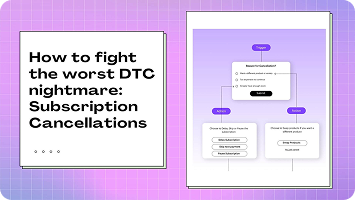
Every high-performing funnel — whether the brand sells supplements, coffee, skincare, or pet food — follows the same three-stage architecture. On average, each stage saves a share of the subscribers who reach it, and stacking all three is how the strongest brands climb past a 20% save rate.
Before any survey or offer, the subscriber sees a page that reminds them what they would lose — upcoming deliveries, loyalty rewards, discount tiers, or a results timeline. That last one matters most for supplements, skincare, and haircare, where the product simply needs time to work. A customer three weeks into a hair-growth or collagen routine hasn't seen results yet — not because the product failed, but because it hasn't had enough time to work. If they hit cancel at that moment, a discount answers a question they never asked. What changes their mind is being told plainly that three weeks is early, and that most people notice a difference months in. That reframes the moment as impatience rather than disappointment. Done well, a re-engagement page can save up to 20% of subscribers without giving away a single offer. Tone matters: empathetic, value-forward copy ("We'd hate to see you go — here's what you'd miss") outperforms "ARE YOU SURE??" urgency. Adding a founder or product video lifts save rates +35% versus static content — hearing the timeline from the founder is more convincing than reading it on a page — and brands such as Livingood Daily use a founder message here to reassure early-stage subscribers who are cancelling out of uncertainty rather than dissatisfaction.
The subscriber selects why they're leaving, and the flow uses that answer to trigger a specific alternative — not a generic coupon. Keep the survey to a handful of brand-specific reasons and serve a matching action for each. Most saves happen in Stages 1 and 2, before any offer is given away, which is exactly why the survey matters more than the discount. Route quality or service complaints to support (via pause, skip, and swap or a live chat handoff) so they never reach the final cancel step.
If the subscriber declines the alternative, they see a final offer calibrated to their reason and value. Limit this to two offers — one alternative action and one incentive. Two offers produce the best save rate (≈14.7%); three or more create decision fatigue and lower conversion. Configure the incentive by reason and by subscriber, not as one blanket coupon: a price objection may warrant a steeper discount than a "want something different," and a second-order subscriber shouldn't see the same offer as a twelfth-order one. Newer subscribers haven't proven their value yet, while long-tenured, high-LTV subscribers are worth protecting with a richer offer. A one-time, targeted discount — offered only when the reason is price-related — protects margin and avoids training subscribers to cancel for coupons.
The highest-performing flows map each cancellation reason to a specific alternative. This framework mirrors the mapping Loop's brands use in Stage 2:
The trap to avoid: offering a discount to someone who said "not seeing results." It signals you didn't listen and wastes margin on an objection that isn't about price.
Want the whole framework in one place? Grab Loop's free Cancellation Flows Playbook — the reason-to-offer mappings, offer benchmarks, and setup checklists behind every save rate in this guide.
Not every cancellation can be saved. Life reasons — a pet passing, medical issues, allergic reactions, or a genuine move away from the category — rarely can be, no matter the offer. Skip the alternatives, express empathy, and route these to a clean exit with feedback capture. Spend retention budget where it has the highest probability of working, and treat the reasons you collect as free product intelligence.
The reasons that matter differ by vertical, so the survey should too:
The mushroom-coffee brand built a different re-engagement page per product category and layered order-count-specific messaging (a 1–4 order subscriber sees different content than a 5+ order member). Because cancellation flows are iterative, that personalisation compounded over time: with 8 re-engagement pages and 11 configured reasons, Four Sigmatic reached a 22% overall flow save rate as of early 2026 — measured across the whole flow, not just the offer screen, where their case study breaks down the offer-page save rate.
TruHeight's reason survey surfaced that "taste/texture issues" drove 30% of cancellations. They reformulated based on that feedback and saw cancellations drop, while the flow itself held a 20.5% save rate. Retention was only part of the story: alongside the cancellation flow, milestone rewards and smart dunning helped grow their active subscriber base 314% in 12 months. The lesson: the reason survey isn't only for saving subscribers — it's a continuous stream of product intelligence.
After migrating ~130,000 subscribers to Loop in 22 days, the supplement brand layered three initiatives: an exit survey to analyse cancellation reasons, a founder video from Dr. Livingood inside the cancellation flow, and gamified milestone rewards. Livingood Daily reports its overall churn rate moved from ~10% at migration to 2.26%. The founder video alone drove a 13% churn reduction in the target segment within 30 days, and ~4% of that segment chose to pause, skip, or delay instead of cancelling.
(These are brand specific measured results; outcomes vary by brand, vertical, and implementation.)
Track four metrics, and read them by segment rather than in aggregate:
Loop's cancellation analytics break save rates down by reason, offer type, and segment, and the subscription analytics dashboard ties this to churn, LTV, and revenue.
The best flows are iterated, not built once. Test one variable at a time, and wait for at least 100 attempts per variant before trusting a result. High-value variables:
Three changes deliver most of the impact and take roughly half an hour combined — expect a 2–3× save-rate lift:
Here is how it works in Loop Subscriptions — all included in Loop's plans with no per-order fees:
Step 1 — Build the flow in the cancellation flow builder: add re-engagement pages, survey questions, and save offers. No developer help needed.
Step 2 — Map each reason to a specific action, so the right alternative is served automatically.
Step 3 — Add personalisation by subscription age, order count, lifetime value, and product type — first-time and repeat cancellers should see different flows.
Step 4 — Embed a founder or product video for high-impact segments such as early-stage subscribers.
Step 5 — Monitor and iterate with cancellation analytics.
Already on another platform? Migrating to Loop is white-glove and handled by a dedicated team at no extra cost, so switching doesn't mean rebuilding your flow from scratch.
Best practice, and the direction of regulation, is simple: cancellation should be at least as easy as signup. Keep the cancel option visible in the customer portal, keep the flow to a few screens, and let subscribers finish without contacting support. Counter-intuitively, frictionless cancellation tends to raise save rates — subscribers who feel respected are more open to alternatives, while those who feel trapped churn passively through failed payments and ignored emails.
The cancellation page is the last conversation you have before a subscriber leaves. The brands saving the most do three things: keep the flow short, match the offer to the reason instead of defaulting to discounts, and treat the moment as a service rather than an obstacle. It's why 2,400+ Shopify subscription brands — including 1,100+ that migrated to Loop — run their retention on infrastructure processing $4B+ in subscription revenue. For teams choosing the best subscription app for Shopify with cancellation control, that combination of Loop's retention tools is what turns the cancel page into a save surface.
Ready to stop losing subscribers you could have saved? Book a churn audit and we'll show you what churn is actually costing you — and where your cancellation flow is leaking.
Q. What is a good save rate for a subscription cancellation flow?
A generic, no-context discount saves about 6% of cancel attempts. A structured three-stage flow saves about 15% on average, and the best-optimised brands reach 20%+ — Four Sigmatic hit 22% and TruHeight 20.5%. Track it alongside 90-day retention of saved subscribers, since a save that churns a month later is really a delay.
Q. How many stages should a cancellation flow have?
Three: a re-engagement page, a reason survey with a tailored alternative, and a final offer if the alternative is declined. Limit the final step to two offers — one alternative action and one incentive. More than two creates decision fatigue and lowers conversion.
Q. Which save offer works for which reason?
Skip or downgrade for "too expensive"; skip, frequency change, or pause for "too much product"; education or a delayed order for "not seeing results"; a product swap for "want something different"; a support handoff for quality issues; and a pause with auto-resume for "just need a break." Match the action to the objection rather than defaulting to a coupon.
Q. Does a founder video actually help?
Yes — in Loop's data a founder or product video lifts save rates about 35% versus static content, and it works best for early-stage subscribers (roughly orders 2–4) who cancel out of uncertainty rather than dissatisfaction. Livingood Daily, for example, reports its founder video drove a 13% churn reduction in the target segment within 30 days.
Q. What's the difference between a cancellation flow and dunning?
A cancellation flow handles voluntary churn — subscribers who choose to leave. Dunning handles involuntary churn — failed payments. About 1 in 8 subscription payments fail, and most brands recover under 20% of them; smart dunning raises median recovery to around 52%. A complete strategy needs both.
Q. How do you reduce customer churn for a DTC brand?
Attack both kinds of churn. For voluntary churn, add a reason-mapped cancellation flow that matches an alternative to each reason instead of defaulting to a discount — the best way to reduce churn on Shopify without eroding margin. For involuntary churn, use smart dunning to recover failed payments. Then measure save rate and 90-day retention by segment so you know which fixes are actually working.
Q. What tools help analyse churn rates for Shopify subscriptions?
Look for a subscription app that reports cancellation analytics — save rate, cancellation reason, offer type, and 90-day retention of saved subscribers — alongside broader subscriber and revenue metrics. Loop breaks all of these down by segment, so you can see exactly where subscribers are leaving and which parts of the flow are converting.