.avif)

Every time a subscriber clicks "Cancel," they're handing you a diagnosis. The problem is, most Shopify brands either don't ask why—or ask and do nothing with the answer.
Here's what the data actually says. Chargebee's 2024 Retention Benchmarks—aggregated across thousands of subscription businesses—found that 31% of all voluntary cancellations cite price as the reason. Not product quality. Not shipping. Price. Another 16% say they have too much product. And 15% want more variety. These aren't vague complaints. They're specific, solvable problems with specific, proven solutions.
Meanwhile, McKinsey's subscription commerce research found that nearly 40% of ecommerce subscribers have cancelled a subscription—and more than half do so within six months of signing up. The window to intervene is smaller than most brands realize.
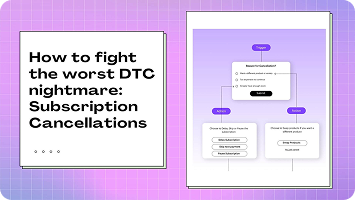
But here's the part that changes the math: well-designed cancellation flows—the ones that capture the reason and present the right alternative—save 20–35% of subscribers who would otherwise leave. Not with generic "Are you sure?" popups. With personalized save offers matched to the exact reason behind the cancel click.
This is what that looks like in practice—the five reasons subscribers actually cancel, and the save offers that actually work. The difference is, the brands that actually track this data know exactly which levers to pull. The brands that don't are spending money acquiring subscribers they'll lose for reasons they'll never understand.
Price is the leading driver of voluntary cancellation, and it's been climbing. Chargebee's data shows pricing-related cancellations have risen to 31%—up from historical averages closer to 20%—driven by inflation, subscription fatigue, and consumers actively trimming their monthly commitments.
But "too expensive" rarely means the subscriber hates your product. It means the perceived value doesn't justify the cost at this moment. That's an important distinction, because it means the right intervention isn't a permanent price cut—it's a temporary bridge that resets the value equation.
When a subscriber selects "too expensive" in the exit survey, the highest-performing response is a targeted discount—15–25% off the next 2–3 orders. Not a permanent price reduction. Not a vague "we'll give you a deal." A specific dollar amount applied with one click.
Industry data from retention platforms consistently shows that discounts drive the majority of accepted save offers during cancellation flows. The key variables are specificity (a concrete amount, not a vague promise), urgency (applied immediately, not "next month"), and time-boxing (2–3 orders, not permanent—this protects your margins while giving the subscriber enough time to re-engage with the product). For a deeper look at how these strategies layer together, see our guide to reducing subscription churn on Shopify.
For price-sensitive subscribers on longer billing cycles, prepaid plans at a deeper discount can be a better path. A 3-month prepaid plan at 20% off locks in commitment and removes the monthly "should I keep this?" decision entirely. Loop's cancellation flows let you configure these discount offers to trigger only for the "too expensive" reason—so you're not giving away margin to subscribers who would have stayed anyway.
This is the most preventable cancellation reason—and the most frustrating. These subscribers like your product. They want to stay. They just don't need another delivery right now.
The problem is almost always a rigid delivery schedule. When the only options are "keep receiving product on the same cadence" or "cancel," subscribers who are sitting on three unopened boxes choose cancel. Not because they want to leave—because you didn't give them a middle option.
When a subscriber says "too much product," the save offer should mirror the problem: skip the next delivery, or extend the delivery cycle from every 30 days to every 45 or 60. This is a one-click action that resolves the subscriber's problem in three seconds. No discount needed. No persuasion required. Just the flexibility they were looking for. The customer portal is where this flexibility lives—skip, reschedule, and frequency adjustments all accessible in a single tap.
Chargebee's research found that 67% of subscribers prefer pausing over cancelling when both options are available. But only 37% of subscribers report actually having a pause option. That gap—between what subscribers want and what brands offer—is where preventable churn lives.
The data insight here is strategic: if "too much product" shows up as a top-3 cancellation reason in your exit surveys, your default delivery frequency is too aggressive. The save offer fixes the immediate problem. But the long-term fix is adjusting your selling plans to offer 45-day and 60-day frequencies by default, or prompting subscribers to choose their cadence at checkout.
Product fatigue is the slow killer of subscription businesses. A subscriber who loved your coffee blend six months ago has simply gotten bored. The product hasn't changed, and that's the problem.
McKinsey's research confirms this pattern: 30% of subscribers cite "lack of fun or new experiences" as a reason for cancellation. They're not dissatisfied with your brand—they're dissatisfied with the monotony. This is especially acute in food, beverage, beauty, and wellness—categories where variety is part of the value proposition.
When the exit survey captures "want something different," the cancellation flow should present a product swap—an inline product picker showing alternatives the subscriber hasn't tried yet. Same billing cycle, same discount, different product. For brands with larger catalogs, Loop's bundle builder takes this further by letting subscribers curate their own subscription box each cycle—turning passive recipients into active curators who are far less likely to cancel.
The swap offer works because it reframes the decision. The subscriber arrived to cancel. Now they're browsing your catalog. The moment they start comparing flavors or shades, they've shifted from "should I leave?" to "what should I try next?" That's a fundamentally different mental state—and it keeps them subscribed. Pair swaps with personalized upsell recommendations in the portal, and every product-fatigue moment becomes a discovery opportunity that deepens catalog engagement.
This is the hardest cancellation reason to save against, because it feels final. The subscriber's needs have changed. They've solved the problem your product addressed. They've moved on.
But "don't need it anymore" is also the vaguest reason—and often masks what's actually happening. Some of these subscribers genuinely don't need the product. But many are experiencing a temporary life change (travel, seasonal shift, budget tightening) that a pause would solve.
For the "don't need it" segment, the most effective save offer is a pause—framed as "take a break, come back when you're ready." One tap, select a duration (1–3 months), and the subscription enters a paused state. The subscriber doesn't lose their pricing, their loyalty progress, or their place in a limited product run.
Chargebee's data shows that paused customers show 2–3x higher lifetime value compared to those who cancel outright. The reason is simple: pausing preserves the relationship. A cancelled subscriber has to re-discover you, re-evaluate, re-enter payment details. A paused subscriber just resumes.
Layer a return incentive on top—"Welcome back! Here's 15% off your return order" triggered automatically when the pause period ends—and you've created a frictionless path back. Loop Flows can automate these return incentives as part of a milestone-based reward sequence, so the subscriber sees a personalized offer the moment their pause window closes.
Involuntary churn—subscribers lost to failed payments, expired cards, and bank declines—doesn't show up in exit surveys because no exit survey was triggered. The subscriber didn't click "Cancel." Their card just failed.
Recurly's analysis across their merchant base found that involuntary churn can account for up to 53% of total subscriber churn. For DTC brands on Shopify, the share typically runs 20–40%, depending on the payment methods accepted and the demographic of the subscriber base. That's one out of every three to five churned subscribers who would have stayed if the payment had gone through.
Most brands don't even know this is happening. They see a subscriber disappear and assume the customer chose to leave. They never investigate whether it was a declined card or an expired payment method—because they don't have the infrastructure to tell the difference. If you're not separating voluntary churn from involuntary churn in your reporting, you're misdiagnosing up to 40% of your losses.
This isn't a cancellation flow problem—it's a payment infrastructure problem. Loop's dunning management addresses it through intelligent payment retries (up to 15 attempts, strategically spaced), backup payment method charging, and pre-dunning notifications that alert subscribers before their card expires. Recovery communications use Quick Action magic links—one tap in an email or SMS updates the card without any portal navigation.
Industry benchmarks show that automated dunning sequences recover 37–70% of failed payments, depending on retry timing and communication strategy. The key is catching failures early—a subscriber whose card is updated before the second retry attempt is far more likely to stay than one who receives a "your subscription has been cancelled" email two weeks later.
The single biggest mistake brands make with cancellation flows is offering the same save to everyone. A 20% discount doesn't help a subscriber drowning in overstock. A pause option doesn't address a subscriber who wants a different product. The data is clear: personalized save offers that match the stated cancellation reason dramatically outperform generic "stay and save" pitches.
Here's the complete playbook:
Loop's cancellation flows support 20+ segmentation attributes, so each save offer can be further personalized based on subscriber tenure, order count, lifetime spend, and product type. A first-time subscriber who says "too expensive" after one order gets a different discount tier than a loyal subscriber on their 12th order who says the same thing. The new subscriber needs to be convinced of value. The loyal subscriber just needs a bridge.
The save offers above only work if you know why the subscriber is leaving. That's why the exit survey isn't just a data collection step—it's the engine that powers the entire retention flow.
And yet, the majority of Shopify subscription brands still don't have a meaningful exit survey in place. They either skip it entirely, use a generic text box that nobody fills out, or collect the data and never connect it to a save offer. The result: they're sitting on a churn problem they can describe by size but not by cause. If you can't break your cancellations down by reason—what percentage is price, what percentage is overstock, what percentage is product fatigue—you don't have a retention strategy. You have a hope strategy.
Every cancellation reason captured in the exit survey serves three purposes simultaneously. First, it triggers the right save offer in real time—"too expensive" routes to a discount, "too much product" routes to a skip. Second, it builds a dataset that reveals systemic patterns over time. If 40% of cancellations in a given month cite price, and you raised prices two weeks ago, that's a direct feedback loop. If "want something different" spikes in month 6, that's a signal to introduce product rotation or variety packs earlier in the subscriber journey. Third, the reason data feeds your win-back campaigns—a subscriber who cancelled for price gets a different re-engagement offer than one who cancelled for product fatigue.
Loop's subscription analytics surface cancellation reason distributions across Revenue, Cancellation, and Subscriptions dashboards—so you can track shifts month over month and measure whether your save offers are actually reducing churn or just delaying it.
Swell's research found that 44% of subscription cancellations happen within the first 90 days of signup. More than half happen within six months. This means the subscriber journey's first three months are the highest-risk period—and the highest-leverage window for intervention.
For the first 90 days, your cancellation flow needs to work differently than it does for established subscribers. New subscribers cancelling for price may need a steeper introductory discount. New subscribers cancelling for product fatigue after one or two orders may need a swap offer sooner. And new subscribers who say "don't need it" may be revealing that your onboarding didn't set expectations properly.
Gamified reward sequences can address the 90-day problem proactively. A mystery reward on the 3rd order, a loyalty unlock on the 5th, and a free gift on the 7th create anticipated touchpoints that keep new subscribers engaged through the highest-risk window. These aren't generic discounts—they're progression markers that make cancellation feel like abandoning a game you're starting to win. Loop Flows automates these milestone-based rewards so they trigger without manual intervention.
The data from thousands of DTC brands tells a consistent story. Subscribers don't cancel because they hate your product. They cancel because of price pressure (31%), overstock (16%), product fatigue (15%), changed needs (15%), or a failed payment they never knew about (20–40%). Each reason has a proven save offer that works—discounts for price, skips for overstock, swaps for fatigue, pauses for changed needs, and smart dunning for failed payments.
The brands reducing churn aren't the ones with the best products. They're the ones listening to the exit survey, matching every reason to the right response, and measuring whether their saves actually stick.
Join 1,100+ brands processing $4B+ in subscription revenue with Loop Subscriptions. Book a demo to see how cancellation flows, flexibility features, and retention analytics work together—or start your free trial and build your first cancellation flow today.
Q1. What are the top reasons subscribers cancel subscriptions on Shopify?
Chargebee's 2024 Retention Benchmarks—aggregated across thousands of subscription businesses—identify five primary reasons: price (31%), overstock or not enough time to use product (16%), desire for more variety (15%), no longer needing the product (15%), and failed payments (20–40% of total churn). Each reason requires a different save offer to address effectively.
Q2. What is a cancellation flow and how does it reduce churn?
A cancellation flow is a multi-step experience triggered when a subscriber clicks "Cancel." It typically includes a benefits reminder (what the subscriber will lose), an exit survey (capturing the specific reason for cancellation), and a personalized save offer matched to that reason. Well-designed cancellation flows save 20–35% of subscribers who would otherwise leave.
Q3. Which save offers work best to prevent subscription cancellations?
The most effective save offers match the stated cancellation reason. Targeted discounts (15–25% off 2–3 orders) work best for price-related cancellations. Skip or delivery cycle extension works for overstock. Product swaps work for variety-seeking. Pausing (1–3 months) works for changed needs. Generic one-size-fits-all offers consistently underperform personalized alternatives.
Q4. Does offering a pause option actually reduce churn?
Yes. Chargebee's research shows that 67% of subscribers prefer pausing over cancelling when both options are available, and paused customers show 2–3x higher lifetime value compared to those who cancel outright. The key is measuring pause return rates—target 75%+ of paused subscribers resuming within the pause window.
Q5. How do I know if my save offers are working or just delaying churn?
Track 90-day retention after save. If 70%+ of saved subscribers are still active at 90 days, your save offers are working. If retention drops below that threshold, your offers are treating symptoms rather than root causes. Also monitor save offer acceptance rate by cancellation reason—if a particular reason has low acceptance, the offer needs rethinking.
Q6. What percentage of subscribers can a cancellation flow save?
Benchmarks vary by implementation quality. Brands starting out typically see 10–15% save rates. Optimized flows with personalized reason-based offers reach 20–30%. Advanced implementations with multiple offer types, segmentation, and escalating incentives push to 30–35%+. Chargebee's aggregate data shows an average deflection rate of 24.4% across their retention benchmarks.