.avif)

Pull up your cancellation reasons from last month. Go ahead—we'll wait.
Now count how many of those reasons could have been solved without a cancellation. "I have too much product." That's a skip. "I need a break." That's a pause. "I want to try something different." That's a swap. "The delivery date doesn't work." That's a reschedule.
If you're like most Shopify subscription brands, 60-70% of your cancellations have a middle-ground solution that isn't cancellation. The problem? Your subscribers couldn't find it—or it didn't exist.
The data on subscription flexibility is striking. According to Recurly's State of Subscriptions report (based on 2,200+ merchants and 76 million subscribers), subscribers who can skip or swap are up to 25% more likely to renew. Chargebee's 2025 Global Consumer Insights study found that 58% of consumers actively choose to pause rather than cancel when given the option. And Recurly's data shows that 25% of would-be churners choose to pause instead of cancel when the button simply exists.
Subscription businesses that implement pause, skip, and swap features see a 20-40% decrease in overall cancellation rates. For a brand with 5,000 active subscribers and a 7% monthly churn rate, that's the difference between losing 350 subscribers every month and losing 210. At $45 AOV and an 8-month average lifetime, each retained subscriber represents $360 in future revenue. That's $50,400 in recovered monthly revenue—from features that cost nothing to activate.
This is the subscription flexibility playbook. We're walking through the four flexibility levers every Shopify brand needs—pause, skip, swap, and reschedule—why each one works, how to configure them in Loop Subscriptions, and the strategies that push flexibility from a churn-reduction tactic to a competitive advantage.
The traditional subscription model was built on rigidity. Subscribe, receive, repeat. The assumption was that friction to leave would keep people subscribed. The reality is the opposite: rigid systems create frustrated subscribers. When skipping, pausing, or swapping products feels hard—or impossible—people cancel instead.
Think about why most subscribers voluntarily churn. They have too much product. They want something different. Their budget is tight this month. They're traveling. Their needs have changed. Notice what all of these have in common: none of them mean the subscriber is done with your brand. Every single one has a middle-ground solution that isn't cancellation.
And the benefits of flexibility compound over time. Recurly's data shows that over $200 million in revenue has been generated from subscribers who re-subscribed after pausing. Three-quarters of subscribers who pause return within months. The pause button isn't a revenue leak—it's a revenue preservation tool.
Companies offering pause options reduce cancellations by 18%, according to ChurnPill's analysis. And this is just one of the four flexibility levers. When you stack skip, swap, reschedule, and frequency adjustment on top of pause, the cumulative retention impact reaches the 20-40% range that top-performing subscription brands consistently achieve.
Each flexibility feature addresses a different cancellation trigger. The key is understanding which lever matches which subscriber need—and making each one available through your customer portal with zero friction.
Pausing is the most powerful flexibility feature you can offer. It's the single alternative that directly replaces cancellation—a subscriber who pauses is a subscriber who didn't cancel.
The data from Recurly is unambiguous: 25% of subscribers who would have cancelled choose to pause instead when given the option. And paused subscribers come back—three-quarters of them resume within months. The pause button isn't giving subscribers permission to leave. It's giving them permission to stay on their own terms.
In Loop's customer portal, pausing is a one-tap action. The subscriber sees the [Pause] button alongside their subscription card, taps it, selects a duration (1 month, 2 months, 3 months, or a custom date), and their subscription enters a [PAUSED] state. No emails to customer support. No waiting. Done in three seconds.
The key configuration decisions for pause are duration limits (most brands allow 1-3 months), whether paused subscribers retain their discount tier, and what happens at the end of the pause period—Loop can auto-resume the subscription or send a reminder asking the subscriber to confirm.
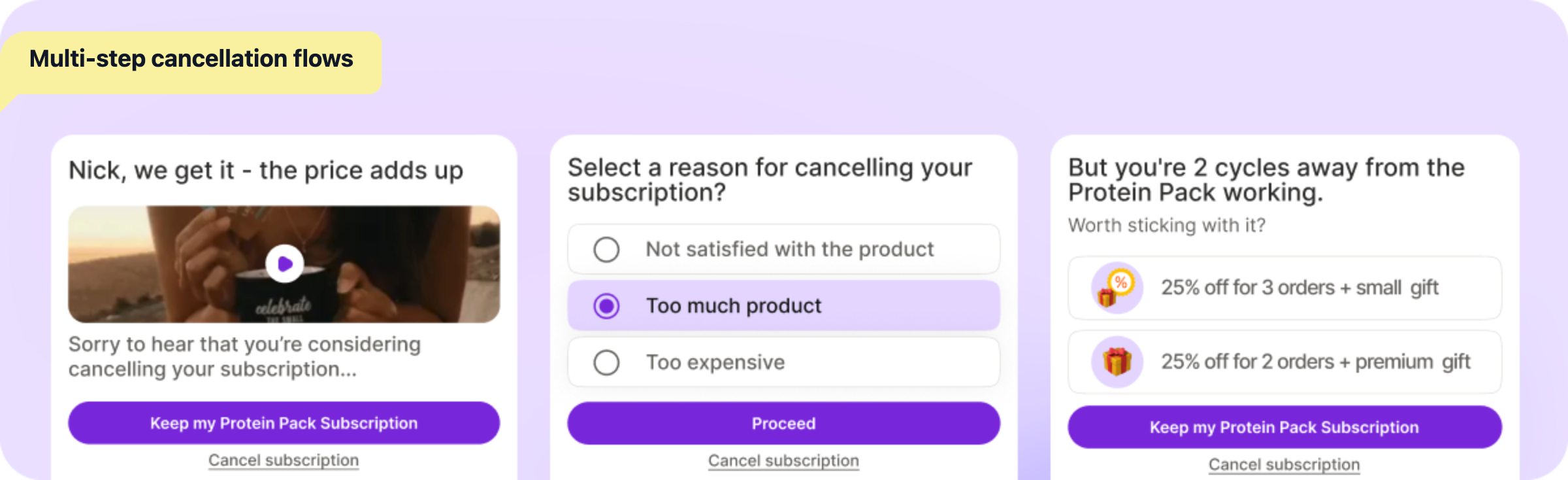
Best practice: pair the pause with your cancellation flow. When a subscriber clicks "Cancel subscription" and selects "I need a break" as their reason, present pause as the alternative: "Not ready to commit? Pause instead—take a break for up to 3 months, and we'll be here when you're ready." This reason-matched offer is one of the highest-converting save actions in Loop's cancellation flow toolkit.
If pause is the hammer, skip is the scalpel. It's smaller, more precise, and often the only thing a subscriber actually needs.
A subscriber who's traveling for two weeks doesn't need to pause their entire subscription. A subscriber who still has half a bag of coffee doesn't need to rethink their relationship with your brand. They just need to skip the next delivery and continue as normal.
In Loop's portal, the subscriber sees their subscription card with a clear [Skip] button: "Skip next delivery." One tap, and their next order is skipped. The subscription stays [ACTIVE]. The following delivery proceeds on schedule.
The revenue math on skips is counterintuitive. Yes, you lose one order. But you keep the subscriber. A subscriber who skips once but stays for 8 more months generates far more revenue than a subscriber who cancels because they couldn't skip. Every skip is a cancellation prevented.
Advanced skip strategy: use Loop's subscription analytics to monitor skip patterns. A subscriber who skips two consecutive orders is signaling disengagement. This is your cue to intervene—not with a cancellation flow, but with proactive outreach: "We noticed you've skipped your last two deliveries. Would a different delivery frequency work better for you?" Catch the problem before the cancel click ever happens.
Product fatigue is one of the most common—and most preventable—causes of subscription churn. A subscriber who's been receiving the same Chocolate Whey Protein for six months doesn't necessarily want to leave. They just want to try Vanilla Bean.
Without a swap feature, their only option is to cancel their current subscription and start a new one. That's two actions instead of one, and between those two actions, life happens—they forget, they reconsider, they find a competitor. You've lost a subscriber to friction that never needed to exist.
Loop's [Swap] feature lets subscribers change their product in one click without cancelling their subscription. The subscriber taps [Swap] on their subscription card, browses available alternatives, selects a new product, and their subscription updates instantly. Same billing cycle. Same frequency. Same discount. Different product.
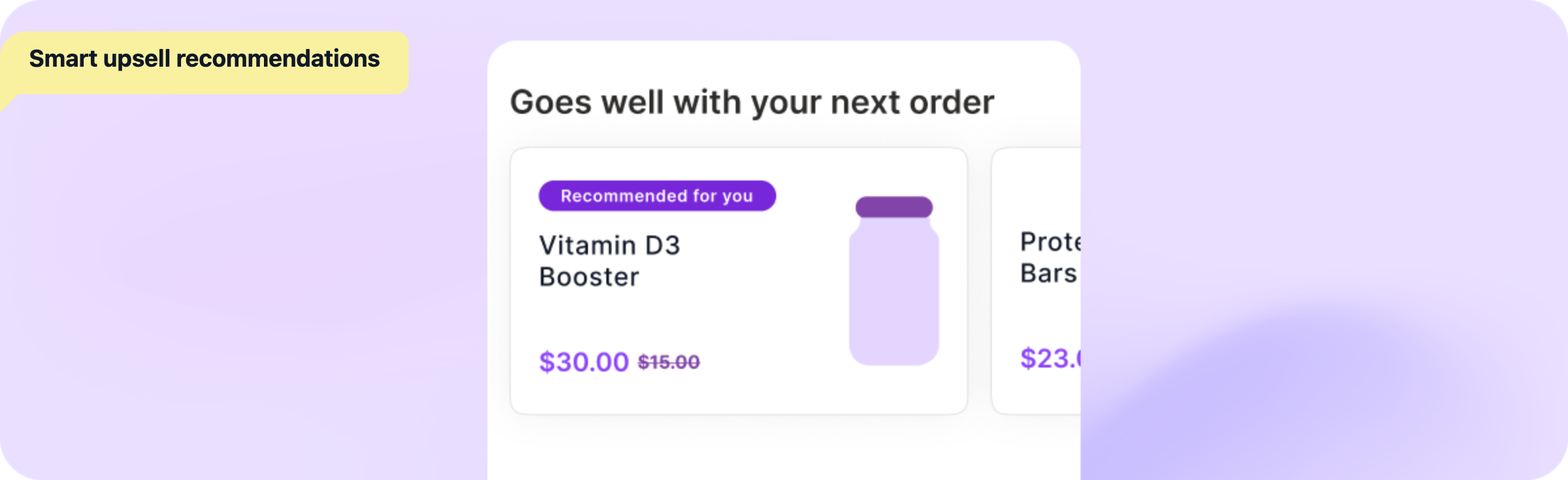
For brands with seasonal products or large catalogs, swaps become even more powerful when paired with Loop's upsell engine. A subscriber swapping their summer moisturizer can see a recommendation: "Subscribers who switched from Summer Glow loved our Winter Hydra. Same price, richer formula." The swap becomes a discovery moment, not just a maintenance task.
Rescheduling is the least discussed flexibility feature, but it solves a surprisingly common problem: the delivery date doesn't work for the subscriber.
Maybe they're on vacation the week their order ships. Maybe payday is on the 15th but their subscription charges on the 1st. Maybe they just want their coffee to arrive on Mondays, not Fridays.
In Loop's portal, the [Reschedule] button lets subscribers change their next delivery date. It's a simple calendar picker: "Change delivery date—your subscription, your schedule." The subscriber picks a new date, and Loop adjusts the billing cycle accordingly.
This also ties into Loop's anchor day functionality. Brands can set a specific anchor day—say, the 15th of each month—so that all deliveries for a subscriber align with a consistent date, regardless of when they originally subscribed. This reduces the "why did I get charged on a random day?" confusion that drives support tickets and, eventually, cancellations.

Having pause, skip, swap, and reschedule features means nothing if subscribers can't find or use them. The flexibility lives in the customer portal—and the portal experience determines whether these features actually reduce churn or sit unused.
70% of subscribers visit the customer portal to manage their subscription. When they arrive, they should see their subscription card with every action available in plain sight.
A typical Loop portal subscription card looks like this: "Whey Protein - Chocolate (2 lb)" [ACTIVE]. Next order: January 28, 2026. Deliver every: 30 days. Price: $47.99 (15% subscriber discount). Below that, four clear action buttons: [Skip] [Reschedule] [Swap] [Order Now].
One tap on [Skip], and her next delivery moves out 30 days. No phone calls. No support tickets. Done in 3 seconds. That's the standard Loop sets. When subscribers have to email support or navigate confusing interfaces to make simple changes, they cancel instead.
Loop's portal also surfaces upsell recommendations alongside subscription management. While a subscriber is swapping products or skipping an order, they see: "Recommended for you: Creatine Monohydrate—pairs perfectly with your protein. Subscribers on their 5th+ order get 15% off. [Add to Next Order →]" Every portal visit becomes a potential AOV increase, not just a churn risk.
And if the subscriber does decide to cancel despite all the flexibility available, they enter Loop's cancellation flow—a multi-step retention journey with benefits reminders, exit surveys, and personalized save offers. The flexibility features are your first line of defense; the cancellation flow is your second.


Most Shopify subscription brands set a default delivery frequency—every 30 days is the most common—and assume it works for everyone. It doesn't. A subscriber using a face serum might run out in 45 days. A household cleaning product might last 60 days. A protein powder consumer might need it every 21 days.
When the default frequency doesn't match actual consumption, subscribers accumulate product—and accumulation is one of the top cancellation reasons. The fix isn't a one-time skip. It's a permanent frequency change.
Loop lets subscribers change their delivery frequency directly from the portal—from "Delivery every 30 days" to "Delivery every 45 days" or any custom interval. This solves the root cause instead of treating the symptom.
Use Loop's subscription analytics to identify optimal frequencies. If a large cohort of subscribers consistently skips every other order, your default frequency is probably too aggressive for that product. Consider changing the default or proactively reaching out to high-skip subscribers with frequency adjustment suggestions.
Here's a strategy that turns flexibility features into retention accelerators: use Loop Flows to reward subscribers for using flexibility features instead of cancelling.
Set up a reward flow that triggers when a subscriber uses [Skip] or [Pause]: "Thanks for sticking with us! As a thank-you for managing your subscription instead of cancelling, here's 10% off your next order." You're training the behavior you want—teaching subscribers that flexibility features exist and that using them is rewarded.
Combine this with milestone rewards: "You're 1 order away from a FREE gift!" appears as a banner in the portal. A subscriber who sees this while considering cancellation isn't just choosing between staying and leaving—they're choosing between losing progress and continuing a journey they're invested in.
The best flexibility intervention happens before the subscriber even opens their portal to make a change.
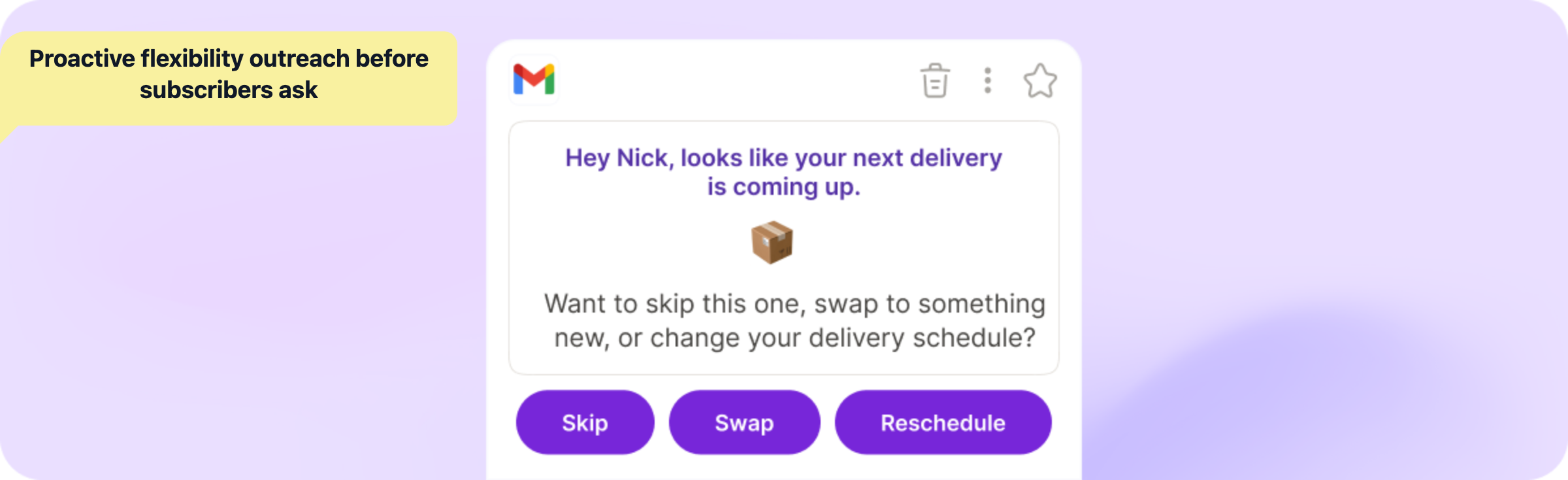
Loop integrates with Klaviyo, Attentive, and other platforms to trigger proactive outreach based on subscriber behavior signals. A subscriber approaching their 3rd consecutive delivery with no engagement is likely disengaging. Instead of waiting for the cancel click, trigger a message: "Hey [Name], looks like your next delivery is coming up. Want to skip this one, swap to something new, or change your delivery schedule? [Skip] [Swap] [Reschedule]"
These are Quick Actions—magic links embedded in emails or SMS that let subscribers take action in one click without navigating to the portal. The subscriber taps [Skip] directly from the email, and their order is skipped. Zero friction. The flexibility comes to them.
This proactive approach is especially effective when combined with payment event triggers. Loop sends recovery communications through its dunning management system, but the same infrastructure can power flexibility reminders. A subscriber whose card is about to expire gets an "Update your payment method" Quick Action. A subscriber approaching their 5th order gets a "Your free gift ships with your next delivery!" reminder.
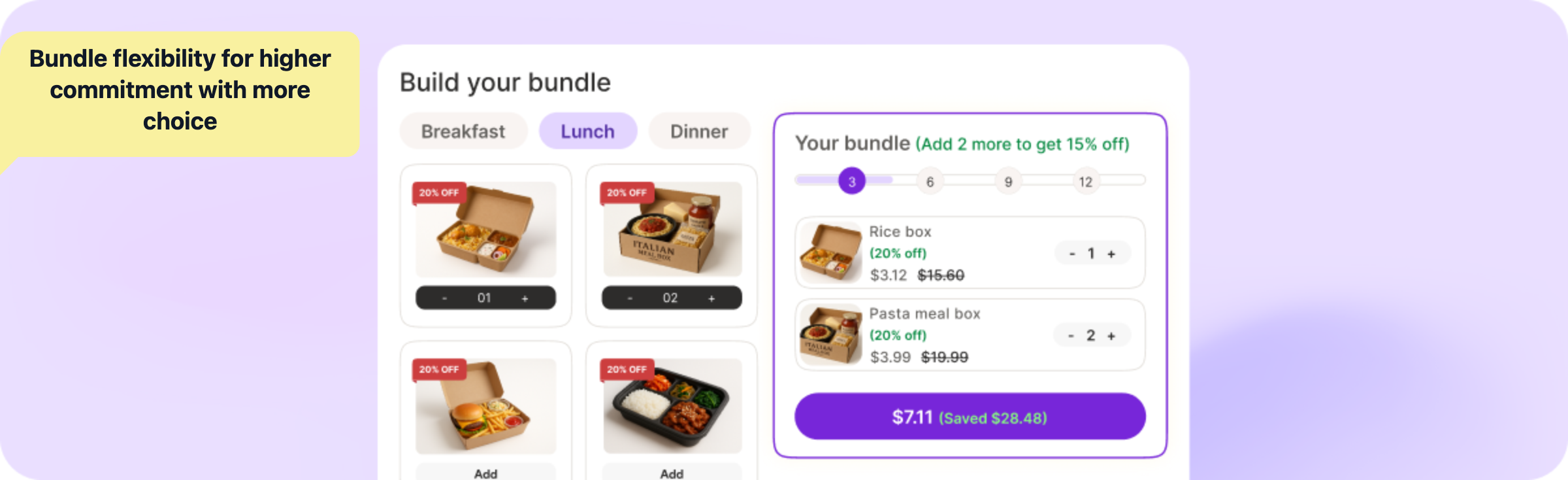
Subscribers locked into a single product are more likely to churn than subscribers who've curated a personalized subscription box. Loop's bundle builder lets subscribers build their own subscription box—choosing from your product catalog to create a custom delivery that matches their exact needs.
The real retention advantage comes from bundle flexibility. Let subscribers modify their bundle before each delivery—swap out one product for another, add a new item they want to try, remove something they have too much of. Each modification is a moment of engagement, and engaged subscribers don't churn.
A subscriber who hand-picks five products for their monthly box is far more committed than one receiving a single item. They've invested time in curation. They've explored your catalog. They've built a routine around this specific combination. Cancellation means losing all of that—which is exactly the kind of switching cost that drives long-term retention.
Here's how to configure each flexibility feature in Loop Subscriptions through the admin dashboard.
Enable portal actions. Navigate to your customer portal settings. Enable Skip, Pause, Swap, Reschedule, and Order Now as visible actions on subscription cards. Each action can be toggled on or off individually.
Configure pause rules. Set maximum pause duration (we recommend 1-3 months), whether subscribers retain their discount tier during pause, and the resume behavior (auto-resume vs. manual confirmation). Auto-resume with a reminder email 3 days before is the highest-retention configuration.
Set up swap parameters. Define which products are eligible for swaps within each subscription. For single-product subscriptions, specify which alternatives a subscriber can swap to. For bundles, define the product catalog available within the bundle builder.
Configure frequency options. Set the available delivery frequencies—common intervals are 7, 14, 21, 30, 45, 60, and 90 days. Use your analytics data to identify the most common skip patterns and add corresponding frequency options.
Map flexibility to cancellation flows. In your cancellation flow builder, map each cancellation reason to the appropriate flexibility alternative. "Too much product" → Skip. "Need a break" → Pause. "Want something different" → Swap. "Timing doesn't work" → Reschedule.
Set up proactive outreach. Connect Loop to your email/SMS platform (Klaviyo, Attentive) and configure Quick Action flows that trigger based on engagement signals.
Monitor and iterate. Review your subscription analytics weekly for the first month after launch. Track skip-to-cancel ratios, pause return rates, and swap frequency. Adjust your default delivery frequency and cancellation flow offers based on what the data reveals.
Flexibility features don't operate in isolation. They're one layer of a comprehensive retention strategy that includes every touchpoint in the subscriber journey.
Flexibility + cancellation flows. Your cancellation flow is where flexibility features get a second chance. A subscriber who never used the skip button might discover it for the first time when your cancellation flow presents "Skip your next delivery" as an alternative to cancelling.
Flexibility + dunning management. Flexibility handles voluntary churn. Loop's dunning management handles involuntary churn—failed payments, expired cards, and processing errors. Together, they cover the full churn spectrum.
Flexibility + gamification. Loop Flows create reward journeys that make flexibility features even more powerful. A subscriber who skips an order but sees "You're 1 order away from a FREE gift!" is motivated to resume.
Flexibility + upsell. Every flexibility action is a portal visit, and every portal visit is an upsell opportunity. Flexibility drives engagement, and engagement drives AOV.
Flexibility + the subscription widget. Flexibility starts at acquisition. Your subscription widget on the product page should communicate flexibility upfront: "Subscribe & Save 20% • Skip, swap, or cancel anytime." This reduces commitment anxiety for first-time subscribers.
Every cancellation that could have been a skip, a pause, or a swap is revenue you chose to lose. Not because you lacked the technology, but because you didn't give subscribers the options they were looking for.
The flexibility playbook is straightforward: give subscribers control over their experience, make every action one-click simple, present the right alternative at the right moment, and measure everything so you can optimize continuously.
Join 1,100+ brands processing $4B+ in subscription revenue with Loop. Book a demo to see how Loop's flexibility features, cancellation flows, and retention tools can transform your churn metrics—or start your free trial to start building your flexibility stack today.
Your subscribers don't want to leave. Stop making them.
Subscription flexibility refers to the ability for subscribers to pause, skip, swap products, reschedule deliveries, and change delivery frequency—all without cancelling. Chargebee's 2025 research found 58% of consumers prefer pausing over cancelling, and brands that offer these features see 20-40% lower cancellation rates. For Shopify subscription brands, flexibility is the difference between a rigid subscribe-or-cancel model and a retention-first experience.
When subscribers have only two options—stay or cancel—many choose cancellation even when they just need a temporary break. Recurly's data shows that 25% of would-be churners choose to pause instead of cancel, and three-quarters of paused subscribers resume within months. In Loop's customer portal, pausing is a one-tap action with configurable duration limits and auto-resume options.
Skipping delays a single delivery while keeping the subscription fully active on its regular schedule. Pausing temporarily stops all deliveries for a set period. Use skips for one-time situations (travel, overstock on a single delivery) and pauses for extended breaks (budget constraints, seasonal changes). Both prevent cancellation, but skips are lighter-touch while pauses are for longer disengagement.
Product swaps directly combat product fatigue—one of the top reasons subscribers cancel. Swaps let subscribers explore your product catalog without disrupting their subscription. When paired with Loop's upsell recommendations, swaps also become product discovery moments that increase engagement and AOV.
Yes. Loop's portal and cancellation flows support 20+ segmentation attributes. You can offer different flexibility options based on order count, total spend, product type, customer tags, and more.
Track four key metrics: skip-to-cancel ratio (benchmark: 3-5 skips per cancellation), pause return rate (target: 60%+), swap frequency correlated with retention, and flexibility usage by subscriber cohort. Loop's analytics dashboard surfaces all of these.