Last updated: May 2026 · Competitor pricing, features, ratings, and review counts in this post are sourced from each platform's published pricing page, Shopify App Store listing, and (where cited) support documentation. Merchant outcomes cited are as published on the respective Loop Subscriptions case study pages and reflect individual merchant-reported results, not guarantees of typical performance. Full disclaimer below.
If you're evaluating subscription apps for your Shopify store, you're in the right place. In this post, we'll walk through a clear, factual comparison of Ordergroove and Recharge, and then go deeper on what Loop Subscriptions offers — capability by capability — so you can see how it would actually work for your subscription program.
Let's start with a quick look at Ordergroove and Recharge before diving into Loop
These numbers are pulled directly from the Shopify App Store and each platform's pricing page as of May 2026.
Ordergroove
Recharge
Loop
Two things stand out. Ordergroove's minimum is $2,917/month — meaningfully higher than either Loop's or Recharge's paid tiers. Among the three platforms compared here, Loop is the only one with no per-order flat fee at any paid tier.
Ordergroove is a subscription platform that supports merchants across Shopify, Salesforce, Magento, and Commercetools. It's positioned for enterprise and fast-growing brands looking for a multi-platform subscription stack with hands-on account management.
Per Ordergroove's published Shopify App Store listing, the platform offers:
Per Ordergroove's Shopify App Store listing (verified May 2026), Ordergroove is "Free to install" with "additional charges based on scope of program with minimum fees of $2,917 per month." External charges are billed by Ordergroove separately from the Shopify invoice.
Ordergroove integrates with Shopify Checkout and partners including Klaviyo, Gorgias, Attentive, Yotpo, and Churn Buster. Support is provided directly by Ordergroove. To learn more about merchant experience, the Shopify App Store reviews are a good reference.
Ordergroove has a 5.0-star rating from 22 reviews on the Shopify App Store as of May 2026. The app launched in October 2020.
Recharge is one of the longest-running subscription apps on Shopify, also supporting BigCommerce and WooCommerce stores. It has a large catalog of third-party integrations.
Per Recharge's published pricing page and Shopify App Store listing (verified May 2026):
Starter feature set: Subscription-first product page widget · No-code customer portal · Upsell & Cross-sell tools · Smart Cancellation Prevention · Failed Payment Recovery · Analytics & industry benchmarks.
Plus — Starter features plus: Hands-on implementation · Customizable bundles & tiered discounts · Concierge SMS · Loyalty – Rewards · Loyalty – Referral program · Javascript SDK & Storefront API.
Recharge has three plan tiers on the Shopify App Store as of May 2026:
External charges may be billed by Recharge separately from the Shopify invoice.
Recharge integrates with Shopify Checkout, Customer Accounts, Shopify POS, and apps including Klaviyo, Gorgias, Stripe, Avalara, and Attentive.
Recharge holds a 4.8 overall rating with 2,100+ Shopify App Store reviews as of May 2026.
Loop Subscriptions has been built directly with feedback from the DTC community. Over 1,100+ Shopify brands have migrated to Loop from platforms including Recharge, Skio, Bold, Smartrr, and others.
Below is a capability-by-capability look at the Loop product. Each section covers what the feature does, how merchants configure it, and what kind of subscriber experience it produces.
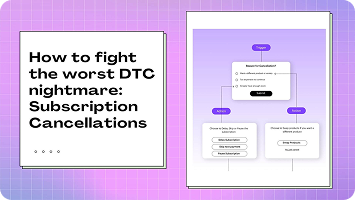
A cancellation click is rarely a single decision. Loop's cancellation flows treat it as a sequence — four stages, each with its own logic — that merchants configure visually, without code.
Stage 1 — Benefit reminder. When a subscriber clicks Cancel, Loop opens a personalized content surface that reminds them why they originally subscribed. Merchants can embed videos and GIFs, highlight exclusive subscriber pricing and rewards, and preview upcoming perks (the next free gift, the next loyalty milestone, an upcoming product drop). HTML support means the surface matches brand voice exactly.
Stage 2 — Exit survey. Subscribers who continue past the benefit reminder see a customized cancellation reason survey. Reasons can be personalized based on the subscriber's order history — a first-order subscriber sees different reasons than a subscriber on order #8. Every response is captured and feeds into cancellation analytics so merchants can identify trends across products, segments, and customer lifecycle stages.
Stage 3 — Smart alternatives. Once a reason is selected, Loop's logic engine suggests alternatives that match the reason. "Too much product" triggers a frequency change or a skip. "Wrong product" triggers a one-click product swap. "Taking a break" triggers a pause. The system uses conditional logic — subscriber value, order count, and the cancellation reason itself — to choose what to surface.
Stage 4 — Conditional offers. If alternatives are declined, Loop presents a targeted offer. Different cancellation reasons and different customer values trigger different offers — a discount for a price-sensitive subscriber, a free gift for a high-CLTV subscriber, free shipping for a logistics complaint. Merchants set the rules. Loop runs them.
OSEA Malibu's implementation of this four-stage flow took churn from 10% to 5% over six months and grew upsell revenue contribution from 4.5% to 6.8%. BEAM Supplements reports a ~30% reduction in cancellation rate within three weeks of adding a founder video to their cancellation flow.
Loop Flows is Loop's no-code automation builder. Merchants build IF-THEN workflows using AND/OR logic, multi-product selectors, real-time status indicators, and searchable flow logs that show exactly which flows fired and what action was taken.
A few of the workflow patterns Loop merchants build most often:
Loop Flows includes guardrails like duplicate-discount protection — if a flow would stack a promo on top of an existing discount, Loop blocks it so margins stay intact.
Loop's customer portal is fully customizable — themes, custom sections, branded look and feel — and built around one-click actions: Skip, Reschedule, Swap, and Order Now are all available directly on the subscription card without extra navigation.
Two capabilities sit at the center of the portal:
Quick Actions. Loop exposes one-click controls for the actions that drive the most CS tickets in subscription programs — payment method updates, order skips, reactivations.
Gamified rewards journey. Merchants can build visible milestone journeys directly into the portal — "you're 1 order away from a free gift," "you've unlocked VIP pricing." This is the mechanic OSEA Malibu used to keep subscribers engaged and visibly invested in continuing the program.
Failed payments are one of the largest sources of involuntary churn. Loop's smart dunning is included in every paid plan — no separate vendor required.
The Starter plan includes 15 automated retries. When a payment fails, Loop triggers a recovery sequence — email plus SMS — with a one-click payment update link that takes the subscriber straight to a payment update flow without needing to log in. Recovery analytics show which retries succeeded, which subscribers updated payment methods, and which churned, so merchants can tune the cadence over time.
Loop's bundle builder supports fixed bundles, curated bundles, and full Build-Your-Own-Box experiences. Merchants can configure incremental discount structures (the more items added, the deeper the discount), white-label the BYOB selection interface, and ship bundles as subscriptions or one-time purchases — all without developer time.
Lilac St. used Loop's bundle setup with a "Buy More, Save More" structure and reports a 72.7% increase in subscription revenue within 11 months, with total subscriptions activated growing 55.2%. Ever Eden used Loop's bundle builder alongside a dual-pricing strategy on Loop's selling profiles, and reports 8X growth in subscriber acquisition across an October–December measurement window. The team attributes 156% YoY subscription growth to bundle-focused replenishment emails (per A/B testing).
Results reflect each merchant's measured experience; outcomes vary by brand, vertical, product, and implementation. The October–December comparison spans the holiday gifting period, which typically influences beauty category subscription growth.
Loop offers a Free Forever plan with core subscription features for up to 50 active subscriptions. The Starter plan is $99/month + 1.0% per transaction with no per-order fee. The Pro plan is $399/month + 0.75% per transaction with no per-order fee. A custom Enterprise tier is also available.
See the full Loop pricing breakdown →
Every Loop merchant gets access to a dedicated CSM. On the Pro plan, support is delivered through a shared Slack channel with a dedicated CSM and support POC. Loop integrates with Shopify Checkout, Customer Accounts, and 35+ apps including Klaviyo, Omnisend, Postscript, Attentive, Gorgias, Rebuy, Smile, Stamped, and more.
Loop has a 4.9-star rating from 650+ reviews on the Shopify App Store as of May 2026. The app launched in July 2021.
These are individual merchant outcomes; results vary by brand, category, and platform configuration.
Here is a detailed comparison of Loop vs Ordergroove and Loop vs Recharge.
Q1. How much does Ordergroove cost?
Ordergroove lists "Free to install" on the Shopify App Store with "additional charges based on scope of program with minimum fees of $2,917 per month." External charges are billed by Ordergroove separately from the Shopify invoice.
Q2. How much does Recharge cost?
Recharge lists three tiers on the Shopify App Store: $25/month for the first 50 subscribers (no transaction fees, 60-day free trial), $99/month + 1.49% + 19¢ per transaction (Starter), and $499/month + 1.34% + 19¢ per transaction (Plus). The Plus plan runs on a 12-month term commitment per Recharge's billing FAQ.
Q3. How much does Loop cost?
Loop offers a Free Forever plan (up to 50 active subscriptions), a Starter plan at $99/month + 1.0% per transaction (no per-order fee), and a Pro plan at $399/month + 0.75% per transaction (no per-order fee). Custom Enterprise pricing is also available.
Q4. Does Loop support migration from Recharge or Ordergroove?
Yes. Loop has run 1,100+ migrations to date from platforms including Recharge, Skio, Bold, Smartrr, and Ordergroove. The standard migration timeline is 2 weeks.
Disclaimer
Source attribution: Feature descriptions for Ordergroove and Recharge are based on publicly available information from each platform's Shopify App Store listing, pricing page, and (where cited) support documentation, verified May 2026. Features and pricing may have changed since publication.
Pricing accuracy: Pricing reflects publicly listed rates at the time of writing. Actual costs may vary based on negotiated contracts or plan changes. Merchants should verify current pricing directly with each platform.
Performance claims: Case study results reflect individual merchant-reported outcomes and are not guarantees of typical results. Performance varies based on brand, product category, subscriber base, and implementation.
Editorial Independence: This content is published by Loop Subscriptions. While competitor information is sourced from public documentation, readers should conduct their own evaluation before making platform decisions.
Corrections: If you are a representative of a platform listed and believe any information is factually inaccurate, please contact us at contact@loopwork.co and we will review and correct promptly.