.avif)
KittySpout sells cat water fountains and the filters that keep them running. As subscriptions became the core of the business, founder wanted deeper visibility and more active control over churn and payment recovery.
Working with their Loop CSM, the team rebuilt two things: a personalized cancellation funnel they test continuously, and a dunning setup they tuned over several iterations.
KittySpout saw churn fall from 13.83% (March 2026) to 11.7% (June 2026) and first-cycle payment recovery rose from 48.8% to 57%.
Founded in 2021, KittySpout makes wireless, self-filtering water fountains for cats plus the replacement filters that make it a subscription. The fountain is the front door; the filters are why customers come back every month
KittySpout’s founder started the company with a partner in 2021. By 2026 the fountains were selling, the filters were reordering, and subscriptions had quietly become the core of the business.
Which is exactly when the questions got harder. How many subscribers churned last month, and why? How much revenue was recovered when a card failed? What was a subscriber actually worth over time?
The founder is candid that he didn't have those answers at hand. Subscriptions had been running themselves - email flows nudged renewals, and the system worked well enough that nobody was digging into the numbers. For a founder juggling fifty things, that's an easy place to land. But with a product this sticky - buy the fountain, you'll always need filters - he knew the upside of getting it right was significant.
So he went looking for a platform that could give him three things: clear visibility into the metrics behind recurring revenue, retention tools he could actively test rather than set and forget, and better cost efficiency as they scaled.
The first thing founder’s team went after was the moment a subscriber clicks cancel.
KittySpout rebuilt cancellation from a single "cancel" button into a multi-step funnel - one that adapts to who's leaving and why. But the real change wasn't the funnel. It was treating it as something to test.
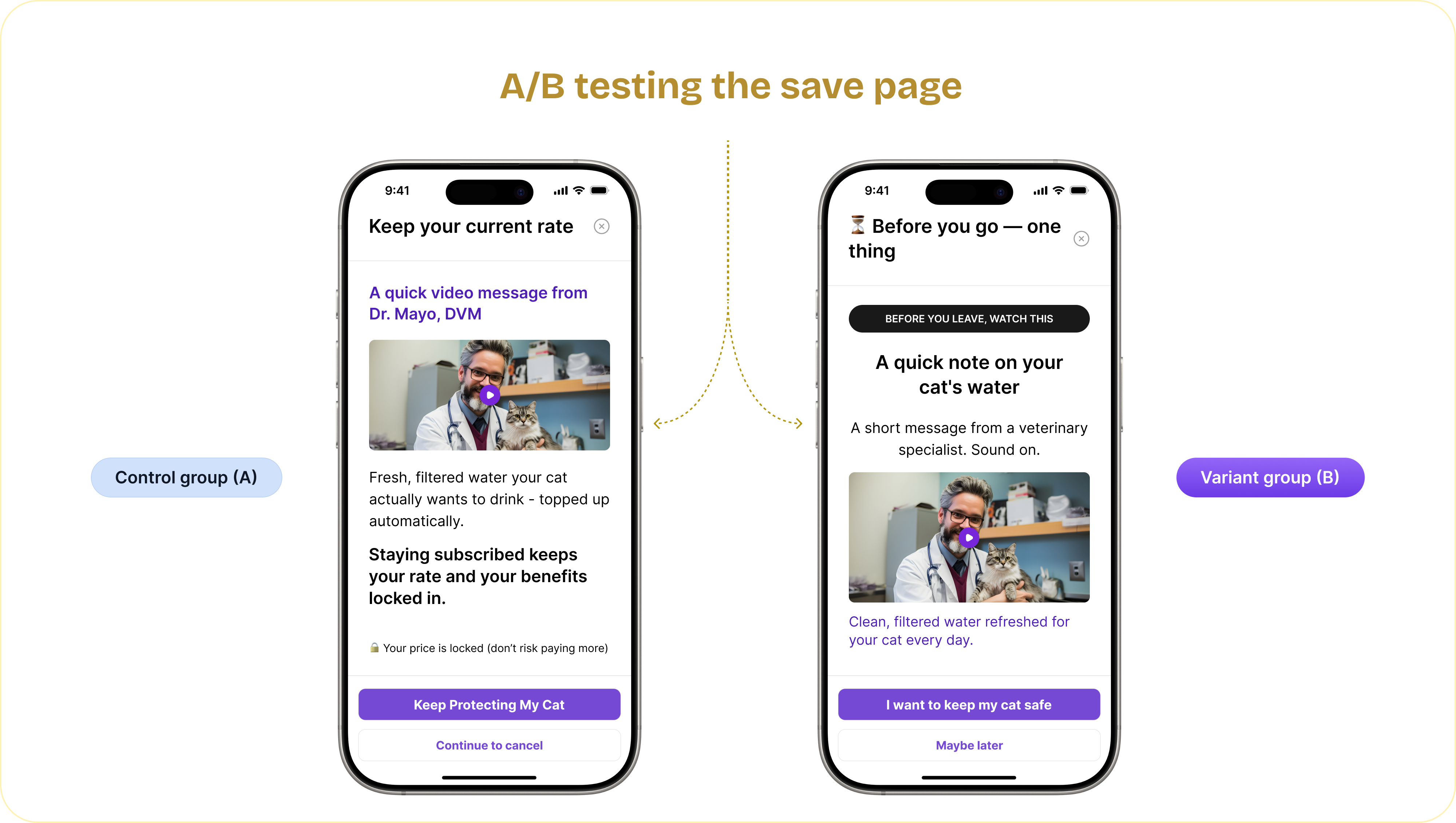
The opening screen is where that shows up most clearly. Before anyone can cancel, they hit a save page and KittySpout runs two versions of it head-to-head: one leading with reassurance, one with an urgent "before you go" hook. They test it down to the button copy. The winning variant is saving 12.08% of attempts vs 8.43% on the control.
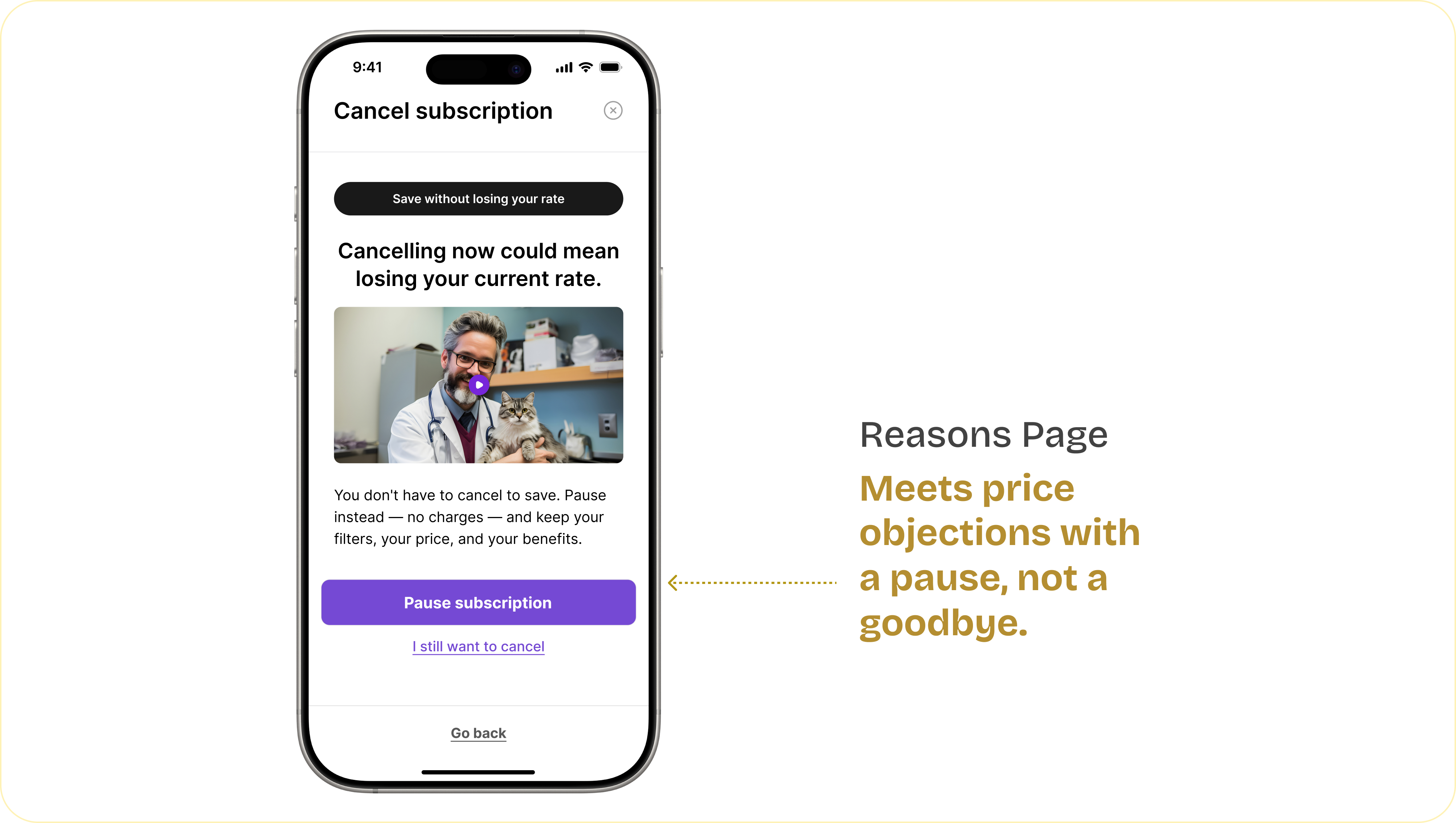
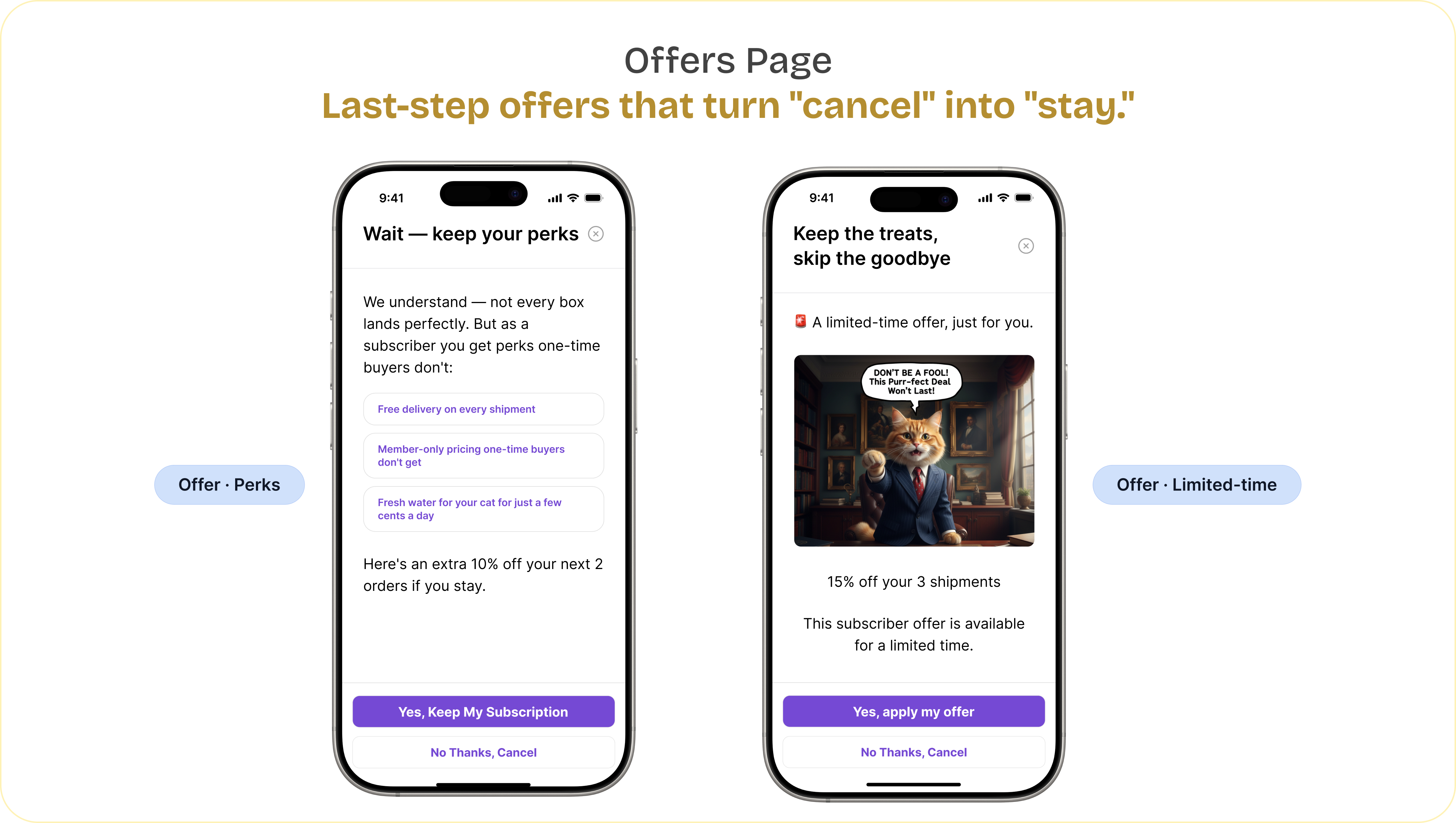
From there the funnel personalizes. Each cancellation reason gets its own page with its own alternative - someone citing price as a reason is offered a pause that keeps their offer rate. Each one carries its own measured save rate, with the strongest saving ~8-10% of attempts. If a subscriber still leaves, a reason-matched offer is the last step.
KittySpout was early to Loop's instant-winback offer - a one-time, expiring offer surfaced the moment a subscription cancels.
.gif)
The second problem was quieter. Cards fail - expired, insufficient funds, a bank declining a recurring charge and when they do, that revenue disappears without anyone cancelling anything.
Here the hero feature was configurable retries. Rather than accept a fixed schedule, KittySpout and their Loop CSM tuned it in stages - starting at 8 retries, then 10, and settling at 14 - with early attempts running silently, later ones notifying the customer, and the whole sequence staggered across the billing cycle to catch the moment funds land.
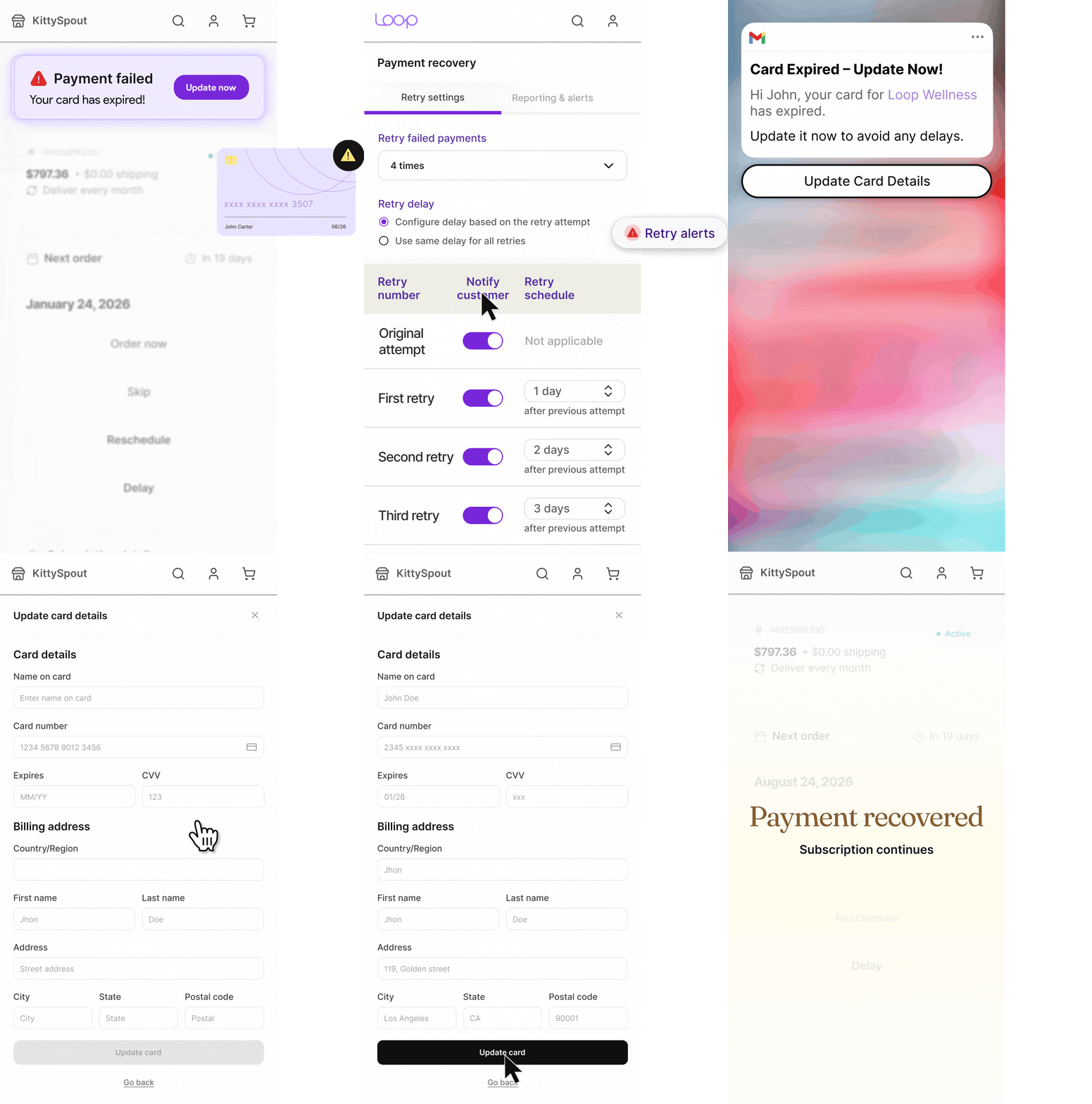
Around that, three settings did the rest of the work: a backup payment method so a failed primary card falls through to a second one; a one-click card update that drops a subscriber straight into the card-update screen in the portal, so fixing a card takes seconds; and pause instead of cancel when retries run out, keeping the subscriber reachable for reactivation later.
With retention steadier, the founder came back with a growth question: how do we lift AOV on a customer we just paid to acquire?
He wanted a post-purchase upsell through AfterSell - an offer on the order confirmation page, right after checkout. The math works: the order's already placed, so it can't hurt checkout conversion. The card's already on file, so it's one click. And it hits at peak intent, at zero extra CAC.
But the founder didn't want to just stack another product onto the order. He wanted the upsell to swap or upgrade the subscription the customer had just started to a bigger size, a better plan.
That's trickier than it sounds. The subscription was already created at checkout. Changing the product inside it seconds later - without leaving the customer on two overlapping subscriptions or getting double-charged meant AfterSell and Loop had to stay in sync.
So Loop built the integration to handle it. Accept the offer, and the subscription created at checkout is cleanly swapped or upgraded. One subscription, right plan, no duplicate charges. For KittySpout this integration was live in ten days.
Now a customer who buys a fountain can be moved up to a better plan or handed the filters and the new supplement line before they've left the confirmation page.
After rebuilding both flows with their Loop CSM, KittySpout saw:
The recovery line climbs as the dunning setup gets tuned - each iteration compounds into more revenue recovered.
Results reflect KittySpout's measured experience. Outcomes vary by brand, vertical, product, and implementation.
The pattern worth borrowing from KittySpout is a quiet one: retention and payment recovery aren't set up once - they're adjusted continuously. None of the wins came from a single switch. They came from small, repeated changes that compounded - testing the save page, matching offers to the reason someone's leaving, moving the retry schedule from 8 to 10 to 14. The number that moves is rarely the one you tune once. It's the one you keep coming back to.