.jpg)

The second purchase is where BFCM either pays off or doesn't. Black Friday and Cyber Monday 2026 fall on 27 and 30 November, and most Shopify stores score the weekend on one number: orders placed. Shopify merchants generated a record $14.6 billion in sales over BFCM 2025, up 27% year over year, with 81+ million customers buying from Shopify-powered brands.
For a subscription brand, that number means very little on its own. A first order acquired at 40% off is a cost until it becomes a second order, and the gap between those two events is where most BFCM cohorts quietly disappear. This guide covers where the second purchase actually gets won: the subscribe and save offer, where to place it during a sitewide sale, and the cohort analysis that tells you whether your BFCM buyers were worth acquiring.
Subscribe and save is a Shopify offer structure where a customer receives a standing discount in exchange for a recurring order, typically 10–20% off the one-time price. It appears as a widget on the product page, at checkout, or as a post-purchase upgrade offer.
At BFCM it behaves differently than the rest of the year. A standing 15% subscribe and save discount is a strong offer in March and an invisible one next to a 40% sitewide Black Friday sale. This is why subscribe and save works better at or after checkout during BFCM than on the product page — it stops competing with the headline discount and starts competing with the customer's reorder decision instead. Subscription widget design still matters for the rest of the year, but the weekend itself needs a different placement.
The second purchase problem is the gap between a customer's first order and their next one — the point at which an acquired buyer either becomes a repeat customer or stops being a customer at all.
Two distinct things happen to a BFCM cohort around its first renewal, and they need different responses.
Some subscribers cancel before you ever bill them. That's 0-day churn: the share of new subscribers who cancel before their first recurring order. It's your discount-quality signal — a high rate means the offer bought you one order rather than a subscriber.
Others get billed and the payment fails. That's involuntary churn, and it's a dunning problem rather than an offer problem. See involuntary churn management strategies and the complete Shopify dunning management guide.
Both land in the same fortnight in late December. Confusing them means fixing the wrong one. Loop's guide to the subscription KPIs that matter covers where 0-day churn sits relative to the other retention metrics.
Three things stack against this cohort specifically.
The discount selected for price sensitivity. A buyer who arrived because of a 40% offer is, by definition, someone who responds to 40% offers. When the renewal lands at full price, the proposition they said yes to no longer exists.
No habit has formed yet. At the first renewal, many BFCM buyers haven't finished the first delivery. Some bought it as a gift. Some bought it to try. Either way they're being asked to recommit to a product they haven't fully used, which is a different question from the one they answered on Black Friday.
The gap is long and quiet. For a monthly subscription the renewal arrives roughly 30 days later, in late December, when inboxes are saturated and the brand has moved on to January planning. Nothing about the BFCM campaign is still running when the decision actually happens.
Subscriber acquisition cost is front-loaded. The discount, the ad spend and the fulfilment all hit order one. Contribution only turns positive somewhere around the second or third order, which means a cohort that churns before the second charge isn't break-even revenue you failed to grow — it's money you spent and didn't recover.
That's why the first renewal, not the weekend, is the point at which BFCM can be judged. A record Black Friday followed by a January cancellation wave is a more expensive outcome than a quieter weekend with a cohort that renews.
During a sitewide sale, the strongest moments are at checkout or after it, when the subscription decision stops competing with your own discount banner.
These aren't alternatives, they're a sequence — the same offer made again to the people who didn't take it the first time.
A checkout link is the most underused of them. It carries the product, quantity, selling plan and a pre-applied discount, so the buyer only has to enter a card. Add one UTM per channel and paste it into email, SMS, ads or a QR code. Two constraints: links can't be generated for BYOB bundles, and an inactive discount code means the products load without the discount.
Segment before you offer. Show the subscription offer only to one-time buyers, never to existing subscribers, and tailor it to what they bought. A generic offer shown to your whole BFCM list will convert worse than a specific one shown to a third of it.
The instinct is another discount. It's usually the wrong instrument, because the buyer already took one and a second teaches them the real price is negotiable.
Two of these are configurable at the selling-plan level in Loop. Prepaid subscriptions let a customer pay upfront for a set number of deliveries, which removes the renewal decision rather than trying to win it. And selling plans support changing the discount after a specific number of orders, which is how a tiered structure gets built — a deeper rate on order one, tapering to your standard subscribe and save rate by order three. On the rewards side, loyalty programmes that drive repeat purchases work because the value sits past the risk point rather than in front of it.
One constraint worth knowing before you plan: bundles aren't supported on prepaid selling plans, so a prepaid offer and a build-your-own-bundle offer are separate paths, not one combined offer.
Aggregate retention numbers will not tell you whether BFCM worked. The cohort has to be isolated.
If the BFCM cohort's 0-day churn runs materially above a September or October control, the discount was too deep or the offer attracted the wrong buyer. That number should set next year's discount depth. Loop's walkthrough of cohort analysis in D2C subscriptions covers how to build the view itself.
Read all five by cohort. A blended figure averages the BFCM group into a much healthier year and tells you nothing useful.
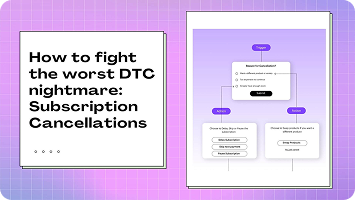
Some of the cohort will cancel regardless, and the cancellation moment is its own retention surface rather than an exit. A flow that asks why someone is leaving and responds to the reason — pause instead of cancel for "too much product", a frequency change for "too expensive" — recovers subscribers that a flat discount doesn't. See the best cancellation flows for Shopify subscription brands and instant winback offers for the recovery path after a cancellation completes.
What is 0-day churn?
0-day churn is the share of new subscribers who cancel before their first recurring order. A high rate usually means shoppers subscribed for the discount rather than the product, which makes it the sharpest number to read on a BFCM cohort. Tiered discounts that grow with each order, streaks and mystery rewards all work against it.
Is 0-day churn the same as a failed second charge?
No. 0-day churn means the subscriber cancelled before you ever billed them, which makes it an offer problem. A failed second charge is involuntary churn, which is a dunning problem. Both spike in the same December window and need different fixes.
When should I make the subscribe and save offer to a BFCM buyer?
At checkout or immediately after, rather than on the product page. During a sitewide sale the product page widget competes with your own headline discount; a checkout upgrade or a pre-filled checkout link competes with the reorder decision instead.
Should I offer a bigger discount to convert BFCM buyers into subscribers?
Generally no. The buyer already responded to a discount, and a second one signals the standard price is negotiable. Prepaid plans, tiered discounts and free shipping from the second order move value past the first recurring order without cutting the recurring price.
How do I know whether my BFCM cohort was worth acquiring?
Isolate the cohort, measure 0-day churn against a non-BFCM control cohort, and read it in January after the first renewal has run. Cohort LTV at order four, read in March, is the fuller answer. Aggregate churn will not show either.
Can I offer subscribe and save without a subscription app?
Shopify's native subscription tools don't include checkout upgrades, conditional offer logic or pre-filled subscription checkout links. Brands add them through a subscription app.
When is BFCM 2026?
Black Friday falls on 27 November 2026 and Cyber Monday on 30 November 2026.