.avif)

Involuntary churn accounts for 20–40% of all subscription churn (per ProfitWell research). Failed payments cost the subscription industry an estimated $440 billion annually (Butter Payments). Recurly's benchmarks across 1,200+ subscription businesses put it plainly: 7.2% of subscribers are at risk of loss each month from payment failures alone.
Your dunning system is what stands between that risk and actual revenue loss.
This guide is the operational reference for Shopify subscription brands—how to structure retries, when to communicate, what to automate, and where most setups leave money on the table.
Billing cycle triggers → subscription app sends charge → Shopify routes to gateway (Shopify Payments/Stripe, Authorize.net, or Adyen) → gateway forwards to card network (Visa, Mastercard) → issuing bank approves or declines.
There are over 2,000 unique decline codes (Recurly). They all map to two categories:
Soft declines: Temporary. Card is valid, account is open, but something blocked the charge right now—insufficient funds, network timeout, bank hold. Recoverable on retry.
Hard declines: Permanent or near-permanent. Expired card, stolen card, closed account. Retrying wastes transaction fees and increases your decline ratio, which payment processors factor into risk assessments for future transactions.
Recurly's research confirms that four of the top five decline reasons are soft declines, with Insufficient Funds showing the highest recovery rate among them. This means the majority of your failed payments can be recovered—if your retry logic is designed for it.
Shopify Payments retries failed charges on a fixed schedule with auto-generated "payment failed" emails. No decline-specific logic, no intelligent timing, minimal customization. Fine for sub-100 subscriber programs. A floor, not a ceiling.
Where most mid-market brands operate. Capabilities vary significantly between platforms.
Basic apps: configurable retry schedules, template dunning emails, customer portal for card updates, simple dashboards.
Advanced platforms go further. Loop's dunning management includes: up to 15 retry attempts with timing optimized by failure type, backup payment methods that auto-charge a secondary card, segmented Quick Actions that tailor incentives by retry count and failure reason, timezone-aware notifications, pre-dunning alerts through Klaviyo and Attentive integrations, and analytics that break down failures by category and gateway.
The advantage: dunning lives inside the same system managing subscriptions, portal, and retention—so recovery works in concert with cancellation flows, engagement tools, and subscriber data rather than as an isolated system.
Specialized providers can layer on top of your subscription app with dedicated retry logic, A/B-tested customer communication, and deep recovery analytics.
Churn Buster, for example, has focused on subscription payment recovery for 10+ years, and integrates directly with Loop, so dunning and subscription data stay in sync. This route fits higher-volume brands that want a dedicated recovery partner. For most brands, Loop's built-in dunning covers the need; a specialist makes sense when recovery is a big enough line item to justify its own tooling and expertise.

The majority of recovered payments come from retries that succeed without the subscriber ever knowing there was an issue.
The mistake: using one fixed schedule for every decline type. Three retries over 72 hours catches a network error but misses an insufficient-funds issue that resolves on the 15th when payroll hits.
Structure retries by decline category:
Most basic apps cap at 3–5 retries. Loop offers up to 15—enough to span multiple pay periods. Loop also auto-identifies unrecoverable declines and skips retries on them, protecting your decline ratio.
Run silent retries before notifying the subscriber. Many soft declines resolve on the next attempt—an unnecessary "payment failed" email creates friction for a problem that would have fixed itself.

When retries aren't enough, the subscriber needs to act. Three variables determine whether they do.
Timing. Don't notify on the first decline—wait until retries have failed and action is genuinely needed. When you do send, send during local daytime hours. Loop sends recovery communications timezone-aware while retries continue in the background.
Tone. "We had a small issue processing your subscription—here's a quick fix" outperforms "PAYMENT FAILED — ACTION REQUIRED." Your dunning emails represent your brand. Loop keeps notifications branded and respectful.
Channels. Email shouldn't be your only channel. Loop integrates with Klaviyo, Attentive, Recart, and other platforms and pipes dunning customer tags for triggered flows across email, SMS, and push.
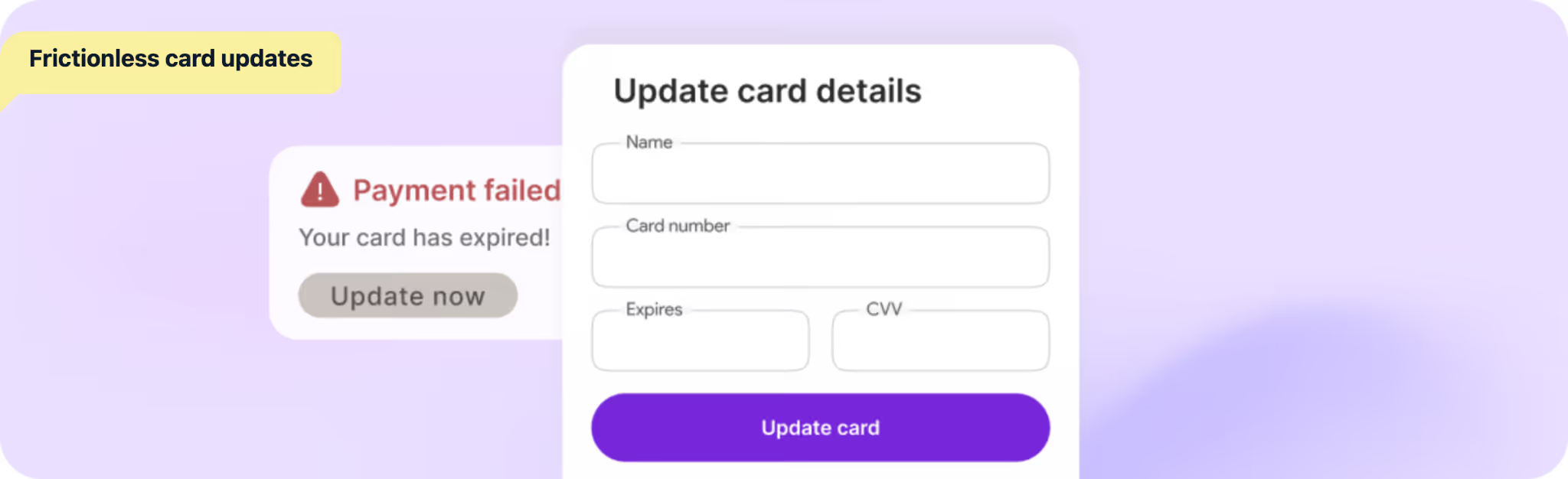
Every step between "payment failed" notification and updated card is a point where the subscriber drops off.
Traditional flow: email → login page → forgotten password → reset email → new password → account settings → payment methods → card update. That's 8+ steps.
Quick Actions collapse this to one. Pre-authenticated URLs in dunning emails open a drawer directly in your branded customer portal. No password. No OTP. No navigation. Mammaly saw 30% of subscribers update payment methods via Quick Actions after migrating from Recharge.
The "update all subscriptions" option in Loop's portal lets subscribers fix payment issues across their entire account in one action—not per-subscription.

Automatic cancellation after exhausted retries is often the wrong default.
Better options: Skip and retry next cycle (subscriber misses one shipment but stays subscribed), pause until resolved (stops billing while preserving the relationship), or cancel as last resort (only after every recovery path is exhausted). Loop lets you configure these outcomes per segment.
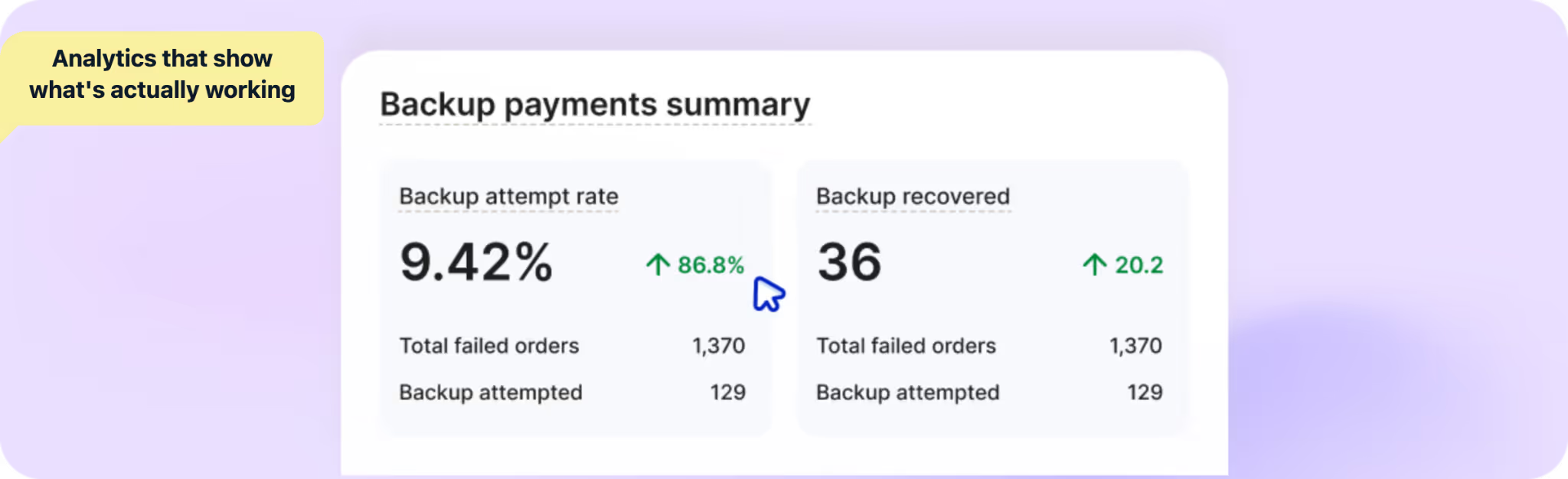
You need visibility into: recovery rate overall, recovery by attempt number (if most recoveries happen on attempts 4–8 but your system caps at 3, you're leaving money on the table), failure reasons by category, revenue at risk vs. recovered, gateway performance, and communication conversion rates.
Loop's dunning analytics track attempted vs. realized payments, revenue recovery trends, failure reasons by category, retry success, and revenue recovered through dunning specifically—across Shopify Payments, Authorize.net, and Adyen.
Pre-expiration alerts. Trigger Klaviyo or Attentive flows 30 days before card expiry. Loop pipes dunning customer tags to these platforms automatically. A simple "Your card expires next month—update here" prevents the failure entirely.
Backup payment methods. If primary fails, Loop auto-charges the backup. No dunning email. No customer action. The subscription stays active. Encourage backup cards in the customer portal—it compounds over time.
Billing date flexibility. If insufficient-funds declines cluster around specific dates, let subscribers choose their billing date through the portal. Align billing with their cash flow.
Phase 1 (Day 3–5, after initial retries fail): Gentle notice. Solution-focused. Include Quick Actions link for one-click card update. No urgency language.
Phase 2 (Day 7–10): Reminder with value reinforcement. Reference their specific product, accumulated rewards, or streak. Introduce escalating incentive. Loop's segmented Quick Actions can serve "Update now and get 10% off your next order" at this stage.
Phase 3 (Day 14+): Direct final notice. Clear on consequences. Stronger incentive if warranted. Segments evaluate priority based on retry count and failure codes—Loop applies the right incentive dynamically.
Review weekly. If insufficient-funds recovery is low, spread retries further across the billing cycle. If expired card recovery is low, strengthen pre-expiration alerts or backup card prompts. If "Do Not Honor" declines spike from a specific bank or gateway, investigate categorization. Recurly's data shows that recovery timeframes vary significantly by decline reason—Insufficient Funds recovers fastest (2–7 days), while fraud-related declines take weeks. Calibrate your windows accordingly.
Loop's segmented Quick Actions let you set conditions based on available retry count, payment failure reason, failure code, and subscription value. High-LTV subscriber on their 3rd failed attempt? Different incentive and copy than a first-month subscriber on attempt #1. Default segments are auto-created; brands refine over time to maximize recovery without over-discounting.
Engaged subscribers update their cards. Passive subscribers don't. Loop Flows build engagement before dunning is ever needed—gamified rewards at milestone orders, mystery rewards, streaks that reward consistent subscription behavior. When a payment does fail, you're reaching an active subscriber, not a ghost.
Subscribers who pay upfront for 3 or 6 months have zero involuntary churn risk for that period. Cancellation flows can offer prepaid conversion as a save tactic—simultaneously reducing churn and removing the subscriber from the dunning equation entirely.
Loop lets you export dunning subscriber data as CSV, tag customers in dunning mode, and generate automated weekly reports for your CX team. Patch Brand recovers approximately 60% of failed payments using this combination of automation and targeted human outreach.
Lumin Skincare: 12.6% revenue boost through payment recovery in 3 months. An additional 3% from retention strategies and 1.4% from portal optimizations—17% total increase from existing subscribers.
Mammaly (migrated from Recharge): 30% of subscribers updated payment methods via Quick Actions. 18% reactivation rate through streamlined customer experience.
OSEA Malibu: Churn cut from 10% to 5% in 6 months using Loop's combined retention and recovery tools—cancellation flows, engagement, and payment recovery as a unified system.
Livingood Daily: Churn dropped from ~10% to ~2% with Loop's retention platform—cancellation flows with founder videos, gamified rewards via Loop Flows, and smart dunning working together.
Dunning isn't a feature to configure once and forget. It's a revenue system with compounding returns—each improvement in retry logic, communication timing, or card update friction pays dividends across every billing cycle, for every subscriber, indefinitely.
Stripe's data shows that subscriptions recovered through effective dunning continue for an average of seven more months. Those aren't one-time saves. They're months of compounding LTV.
Loop's dunning management is built into a complete retention platform—smart retries, backup payment methods, segmented Quick Actions, pre-dunning alerts, and subscriber engagement through Loop Flows all working together.
See what switching to Loop looks like — book a demo.