
INDUSTRY
Health & Wellness
MIGRATED FROM
Recharge

How Beam earned $1M+ from existing subscribers in 12 months

$1 M+
add-on revenue
21%
cancellation save rate
92%
revenue generated of saved MRR
CONTENTS
1,100+ brands migrated
Ready to run the same playbook?
Start with a free audit of your current subscription setup.
Get my free audit ->
Joy Huang profile picture

“Loop has been a game-changer for our lean team. Without an in-house dev, we needed a tool that let us build dynamic, highly personalized subscription offers ourselves - and Loop delivered. Even better, their support feels like a true partnership.”

Joy Huang· VP - Lifecycle & Subscriber Growth· Beam

TL;DR

  • Beam sells daily wellness routines - sleep, gut, hormone balance and a kids' line - which makes the subscriber base its biggest growth channel.
  • The team wanted a subscriber portal it could personalize and run offers in, without a custom build. That's what brought them to Loop in October 2025.
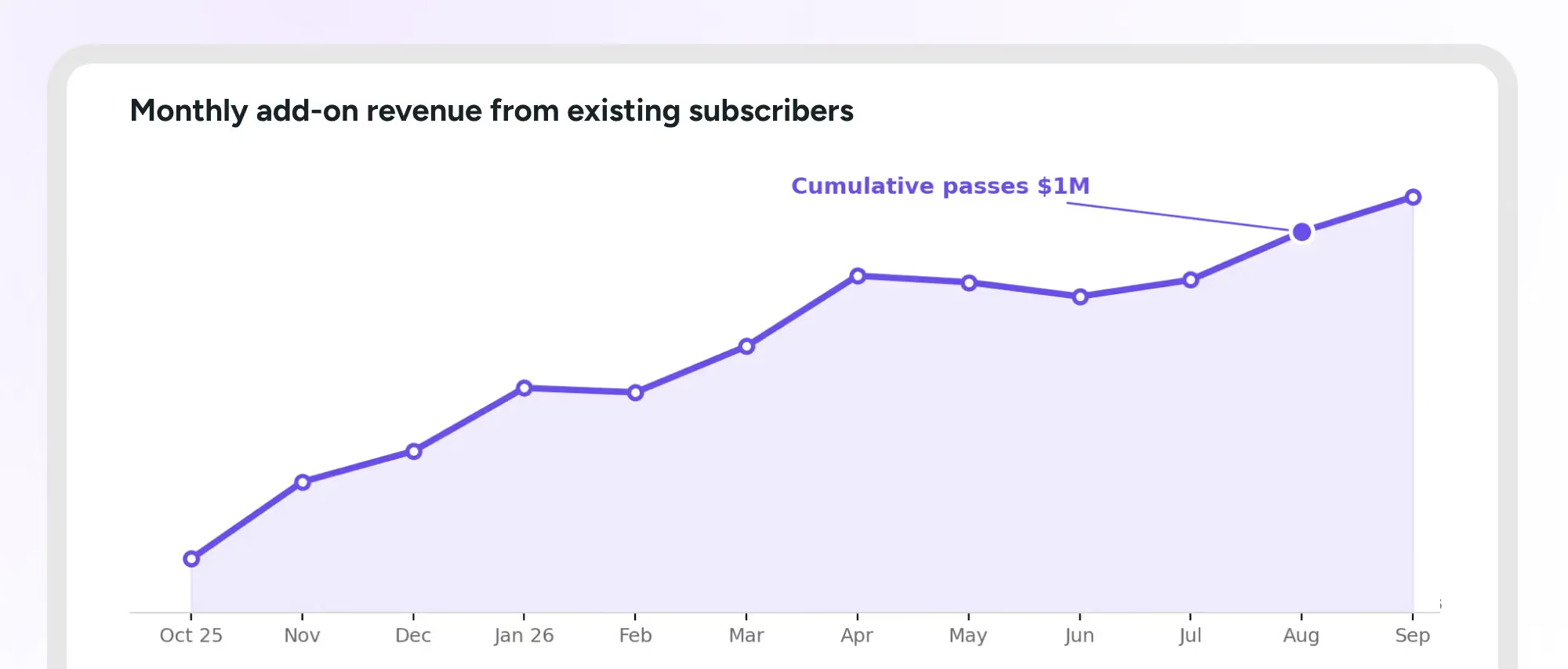
  • Beam crossed $1M in add-on and cross-sell revenue from existing subscribers inside 11 months on Loop driven by targeted portal offers, limited-time campaigns to specific subscriber lists, and one-click links in upcoming order reminders.
  • Its cancel flow saved 21% of cancellation attempts and 92% of the MRR it saved came back as processed orders, the number that tells you a save was real.

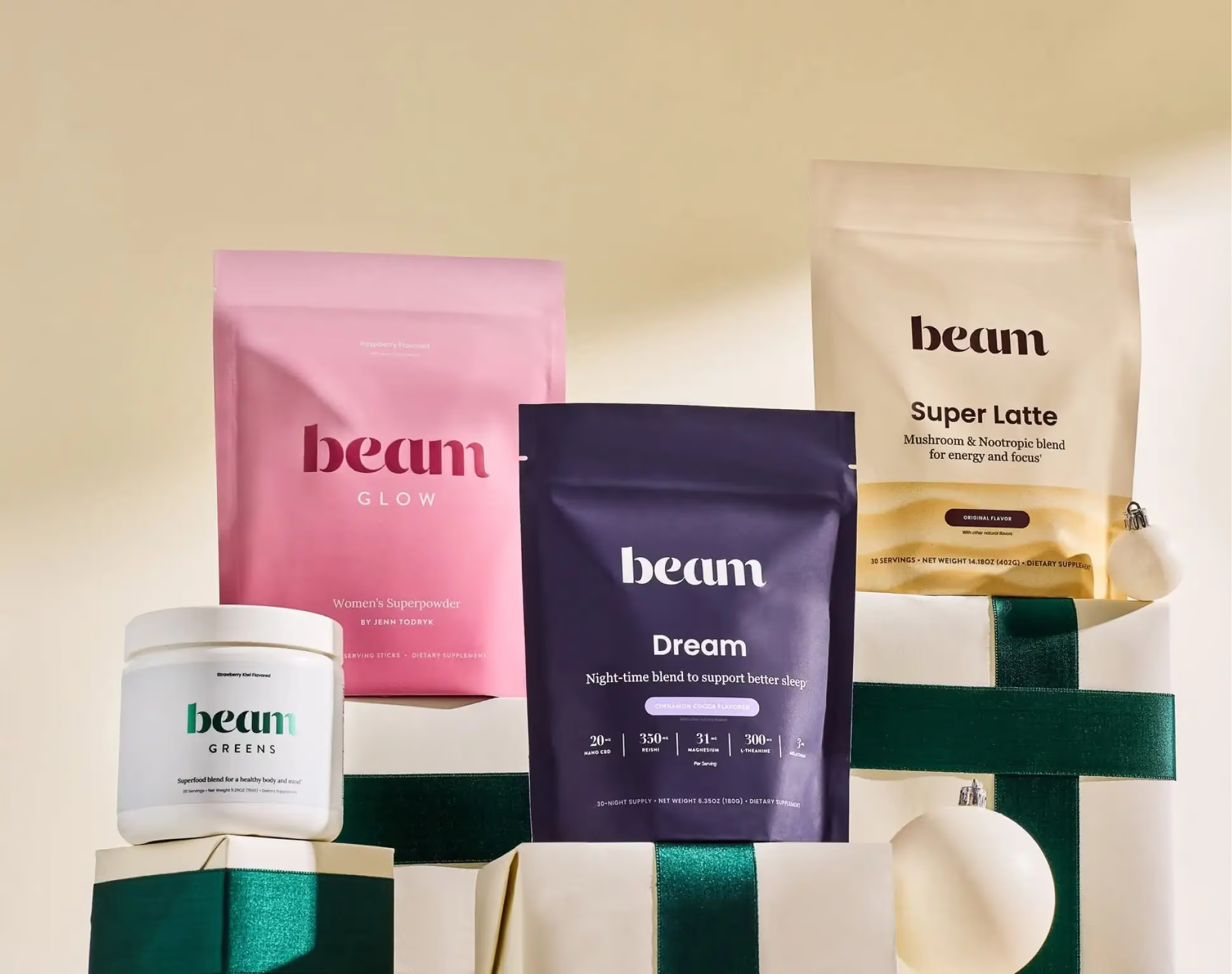
About the brand. Beam sells wellness routines - Dream for sleep, Glow for hormone balance, Biotic for gut, plus collagen, creatine and a kids' line. Products people take daily for months, which makes Beam a subscription-first business. The team ships new flavors, bundles and seasonal drops constantly, and moves quicker than most brands its size.

02

The challenge: a portal Beam wanted to personalize

Beam went to market for a subscription platform for one reason above all others: the team wanted a subscriber portal they could shape - personalize by cohort, run offers inside, and change without a build cycle.

Beam had never meaningfully touched its customer portal. The team took it to their dev agency and asked what customization would involve. The answer was a portal built from scratch, which wasn't a project Beam wanted to own. So it stayed as it was.

For Joy Huang, the bigger miss was what the portal wasn't doing. Beam has a catalog built for cross-sell - sleep next to gut next to collagen and a logged-in subscriber already in the door. But every subscriber saw the same thing, whether they'd been on Glow for a year or started Dream last week.

The day-to-day added up around it. Routine catalog changes turned into manual projects, and reactivation and payment recovery were each running on separate tools alongside the stack.

“I spend a good chunk of time, and other people on my team too, manually bulk updating things every day.” 
‍
— Joy Huang

03

First: the right offer for the right subscriber

The rebuild started with one rule: nobody gets pitched something already in their box.

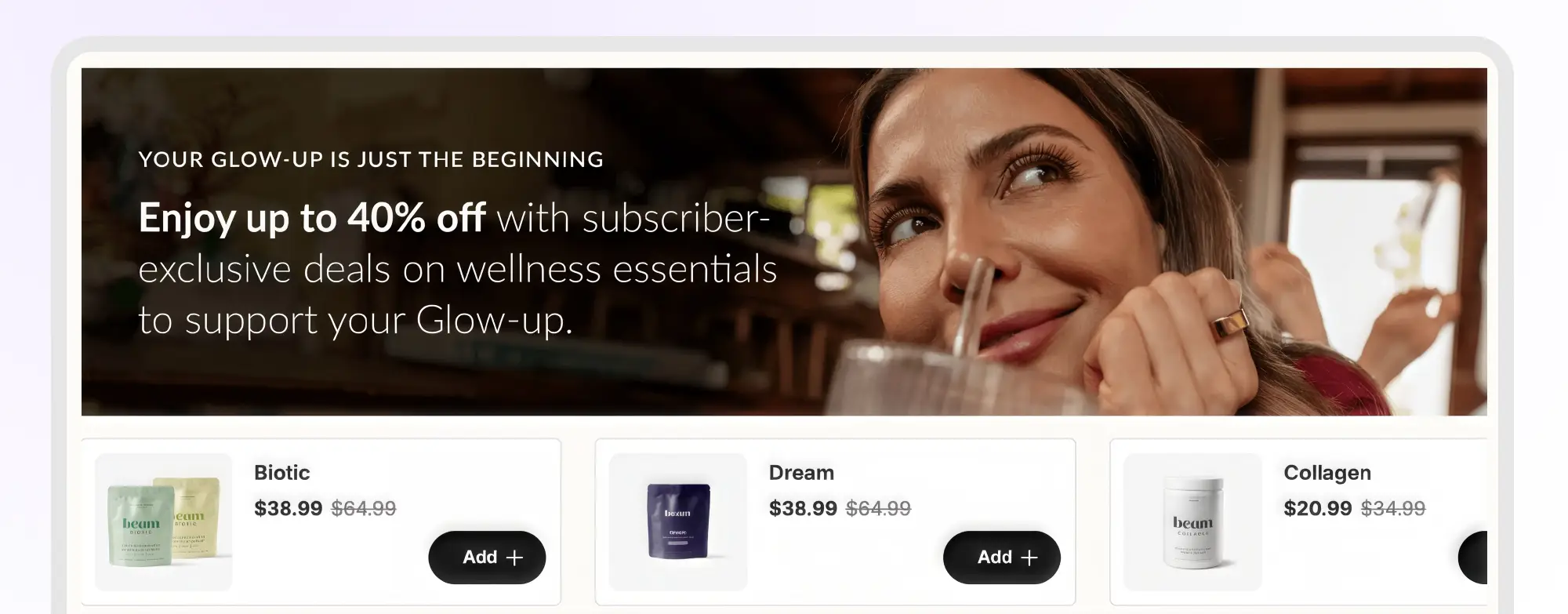
Instead of one product shelf shown to everyone, Beam built personalized upsell/cross-sell profiles in the portal each mapped to what a subscriber already has and what they don't. A Glow subscriber sees what pairs with Glow. A Dream subscriber sees what pairs with Dream. Each cohort gets its own banner creative, so the offer reads as the next step in a routine rather than an ad.

Slide
Slide

Every profile reports on its own, so Beam can see which cohorts are adding products and which aren't - and adjust the list, the order or the creative without touching code.

Beam tracks views, add rate and revenue per upsell profile. 
04

Then: limited-time offers, aimed at a specific list

The portal profiles run all year. On top of them, Beam runs a steady calendar of limited-time campaigns and one-click quick action links. What makes them work isn't the offer - it's how deliberately each one is set up.

Who sees it: start with the list, not the offer

  • Cross-sell into the gap. Target subscribers who have one product but not its natural pair, so the offer is always genuinely new to them.
  • Launch to non-owners only. When a product launches or comes back in stock, send it to subscribers who don't already have it.
  • Save the bigger bundles for higher-value subscribers. Use total spend as a condition, so premium offers reach the subscribers most likely to take them.
  • Go broad only when the ticket is small. Low-cost one-time add-ons can go to every subscription; anything bigger gets a narrower list.

When and where: give every offer a reason and a route

  • Tie each offer to a moment. Launches, restocks and calendar moments give a limited-time offer a real deadline - usually a one-to-three-week window.
  • Match the channel to the list. Portal banners for subscribers already managing their account, email and SMS via Klaviyo for reach, both for priority launches.
  • Use the email subscribers already open. A one-click add-on link in the upcoming order reminder reaches every subscriber right before their next box ships.

What the offer looks like: easy to say yes, protected on margin

  • Trial first. New products lead as a one-time add-on, so subscribers can try without committing.
  • Step the discount down. Where the subscription option is offered, the discount drops after the first order - a reason to say yes now, without discounting the line forever.
  • One claim per subscriber, points applied up front. Offers are capped per campaign, and loyalty points show the final price before anyone commits.
Slide
Slide
Slide
Three of Beam's limited-time campaigns, each built for a different subscriber list.

‍

Every route points at the same place. Whether a subscriber clicks an email, a portal banner or an order reminder, they land on an offer built for the subscription they already have.

05

Saves that actually paid out

Most brands judge a cancel flow by its save rate. Beam's is 21% - a little over one in five subscribers who started to cancel stayed. But a save rate only tells you someone clicked “keep my subscription.” It doesn't tell you whether they paid for another box.

The number that does is how much of the MRR you saved actually came back as processed orders. Across Beam's first 12 months, saved subscriptions went on to generate revenue equal to 92% of the MRR the cancel flow saved, with each saved subscription placing more than one further order on average.

12 MONTHS OF SAVES, generated
~$2.16M

in additional revenue Beam has collected from saved subscriptions since go-live

That gap — or lack of one — is what turns a cancel flow from a retention widget into a revenue line. When saved MRR and additional revenue generated sit this close together, the saves are real. When they drift apart, it shows exactly which offers are buying a click rather than another box.

06

The requests that turned into features

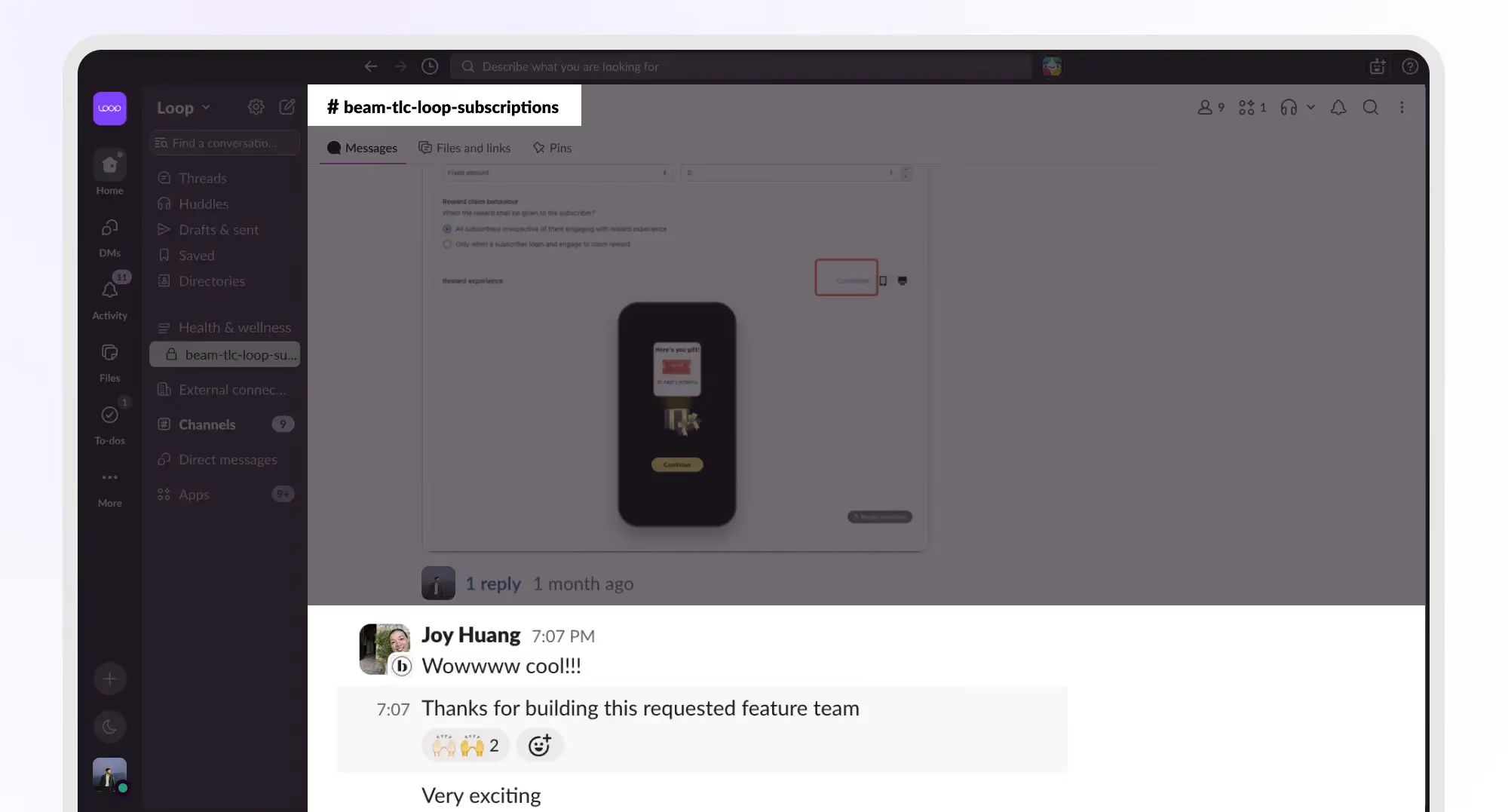
A year in, Beam asks for things the way operators do - specifically, with the use case attached, usually because a launch is already on the calendar. Several of those asks have gone from a message in a shared Slack channel to something live in the product.

“In our first year, they’ve shipped every single feature we’ve asked for. They genuinely listen, collaborate, and help us scale.”
Joy Huang
Joy Huang· VP - Lifecycle & Subscriber Growth· Beam
A request landing back in the shared channel, built.

That's the quiet reason the move stuck. Beam moves fast, and the platform has kept pace - less by anticipating what the team would need and more by building it once they asked.
07

What Beam saw in its first 12 months on Loop

  • Add-on and cross-sell revenue: past $1M from existing subscribers inside 11 months, and still climbing – ~3% of recurring subscription revenue. Monthly add-on revenue grew ~ 7x across 11 months on Loop.
  • Cancellation save rate: 21% of cancellation attempts saved, worth ~$2.36M in saved MRR.
  • Revenue generated from saves: ~$2.16M - 92% of saved MRR turned into processed revenue.

Results reflect Beam’s measured experience; outcomes vary by brand, vertical, product, and implementation.


Key takeaways for operators

  • Build the subscriber list before the offer. Use what's in a subscription, what isn't, and what a subscriber spends to decide who sees each offer - in the portal, in campaigns and in order reminders.
  • Make yes easy, keep margin safe. Time-box offers to a real moment, lead new products as a one-time add-on, and step subscription discounts down after the first order.
  • Measure saves by what revenue they generate. Track saved MRR against revenue generated from saves, not save rate alone, and rework the offers where the two drift apart.
MORE CUSTOMER STORIES
Jun  2026
Retention
OSEA Malibu slashed churn from 10% to 5%, while upsell revenue contribution grew from 4.5%
to 6.8%
Found Loop to be the best fit after extensive testing and achieved a seamless migration in 2 weeks from Recharge.
March 2026
Growth
Good Protein’s subscribers grew by 12x (~6k to 72k), subscription revenue grew by 10x (<$500k/month to >$5M/month).


All while keeping churn under 5%, placing them in the top 10% of brands on Loop.
500+
BRANDS MIGRATED
2 wks
AVG. MIGRATION TIME
See what this looked like for a brand like yours.
Jun 2026
Retention
Four Sigmatic measured 90% rise in subscription cancellation save rate