.jpg)

A BFCM checklist for a subscription brand looks different from a BFCM checklist for a regular store. Most cover inventory, site speed, ad creative and shipping cut-offs — all of which still apply. None of them cover what happens to your selling plans, your renewal dates, or the subscribers who were already going to be charged during the sale.
Black Friday 2026 falls on Friday 27 November and Cyber Monday on Monday 30 November. Shopify merchants generated $14.6 billion over BFCM 2025, up 27% year over year. If you sell subscriptions, the decisions below determine not just what you make that weekend but what renews in January.
For general store prep — inventory, checkout, fulfilment — Shopify's own BFCM checklist covers it properly. This is the subscription layer.
Every extra day of the offer window is another day of renewal dates landing in the same December week. Decide the length deliberately.
1. Let your existing cohorts pick the discount. If you're running more than one selling plan or discount level, you already have a live experiment. In Loop, go to Analytics → Cohorts and filter by selling plan and delivery frequency. Rank plans by how they retain at order three and four, not by checkout conversion — your best converter is rarely your best retainer. Treat September and October as the test window and let the winner set the BFCM offer.
2. Decide whether the discount recurs, then build the plan. First-order only, every renewal, or tapering. Tiered discounts let you set a deeper rate on order one and step down after a set number of orders — the BFCM rate first, your standard subscribe and save rate from order three. Decide before you build, because changing it later means editing live subscription contracts.
3. Set minimum billing cycles. Selling plan settings let you require a minimum number of billing cycles before a subscriber can cancel, specifically to prevent misuse of subscription discounts. If you're discounting steeply, this is the control that protects the cohort. Use maximum billing cycles on gift SKUs so a gifted plan doesn't renew forever.
4. Decide on prepaid, and plan around its limits. Prepaid plans remove the renewal decision entirely, which is the strongest structural answer to discount-driven churn. But prepaid doesn't support bundles or tiered discounts, so a prepaid offer and a build-your-own-bundle offer are two separate selling plans. Decide which leads.
5. Check your anchor day. If your selling plans use an anchor day, every BFCM subscriber charges on the same date in December. Know which date before the weekend, not after.
6. Build your checkout links now. A checkout link takes a buyer straight to a pre-filled Shopify checkout — product, quantity, selling plan and discount already applied. Nothing to do but enter a card. Build one per offer, add a UTM per channel, and deploy them everywhere: email, SMS, paid ads, and inside the portal banner. Each link tracks clicks, conversions and revenue separately, so you learn which channel actually drove subscriptions. Two constraints: no links for BYOB bundles, and an inactive discount code means the products load without the discount.
7. Test a real checkout end to end. Generate a checkout link with your BFCM selling plan, apply a 100% discount code, and complete an actual order. A test payment method won't prove your live payment methods work.
8. Review the widget and plan availability. During BFCM the subscription widget competes with your own sitewide discount, so the value comparison has to be unmistakable. Decide where the BFCM plan appears — storefront, checkout, portal — and where it disappears on 1 December.
Email and SMS reach a slice of your list. Everyone in the customer portal is logged in, already paying you, and one click from a bigger order.
9. Give subscribers first access, and say why. Existing subscribers will otherwise watch new customers get a better deal. Open a portal-only window two to three days before the public sale. The framing is loyalty, not discount: you're a subscriber, so you get it first and you get it cheaper.
10. Merchandise it with an upsell banner above the next-order card. That's the element subscribers look at first, because it tells them what's coming and when. Build upsell profiles targeted at subscriber cohorts with per-product discounts, and go aggressive — 40% off or deeper — because this offer only runs against your existing base. Creative rule: one message, one CTA. Dated window first, then the saving, then the button. The subscriber came to manage an order, so you have about two seconds.
11. Land the add-on on their next upcoming order. The strongest version isn't a separate purchase — it's a discounted product added to the delivery they're already expecting. No new checkout, no new shipping decision, no second payment. The discount hits that order only, never renewals, so a 40% add-on costs you once rather than permanently.
12. Decide on pause and skip for the season. Subscribers can skip consecutive orders while keeping their discount — useful in normal months, worth reviewing before a season with unusually deep offers. Set pause with a defined duration so subscribers auto-resume rather than holding indefinitely.
A sitewide discount is visible to everyone and therefore urgent to no one. A campaign aimed at one segment, running from a stated start time to a stated end time, creates scarcity that's real rather than asserted.
Set the audience — all active, or filtered by product, plan, country or an uploaded CSV — and the exact start and end date and time. Schedule it up to a year ahead. The banner auto-hides on expiry, so there's no stale offer to clean up on 1 December. One build publishes to the portal banner and mirrors to email and SMS, reporting as a single campaign.
An exact end time is urgency you can prove. That's the difference between a deadline and a claim.
13. Early access portal campaigns. These drive subscribers into the portal to take one specific action, with an offer that only exists once they're there. Pick the action first — add a product to the next order, upgrade frequency, extend the plan, clear stock — and tie the campaign to it. The offer is the reason to visit; the action is the point. Running it before Black Friday also warms up portal traffic ahead of the weekend's volume.
14. Winback campaigns to cancelled subscribers. BFCM is the best reactivation window of the year and almost nobody uses it that way. Lapsed subscribers are already shopping, already price-sensitive, and already know the product — no media cost, no education. Make the offer exclusive to that segment and time-box it. A winback identical to your public sale gives a former subscriber no reason to resubscribe rather than simply buy once. "We saved your old plan. Come back at 40%."
15. Order-now campaigns to pull the next order forward. Invite subscribers to bring their upcoming delivery into the sale window — "early BFCM access, just for you." It moves revenue into November, gives subscribers a real benefit for staying subscribed, and takes pressure off December fulfilment. The discount hits that order only, never renewals. Target subscribers whose next order falls in early-to-mid December.
16. Audit dunning retry windows against December. Recurring orders keep shipping through the holidays while card declines rise, and the cohort hit hardest is the one that just signed up. See the dunning management guide and involuntary churn management.
17. Set inventory rules for recurring orders, and brief support. Your BFCM one-time orders and your subscribers' December deliveries draw on the same stock — pause subscriptions containing only an out-of-stock product rather than interrupting multi-product boxes. Then write support's answers in advance: does my discount continue, can I add the BFCM deal to my existing subscription, when am I next charged.
18. Record your baseline now. Current 0-day churn and subscriber churn, so January has something to compare against.
Almost every BFCM checklist stops at the sale. Acquiring the cohort is half the work — the real risk is a subscriber who joined for 40% off cancelling the moment the discount stops, somewhere between the first delivery and the first renewal. Both plays below have to be built before December.
19. Target a mystery reward at the BFCM cohort. Mystery rewards fire when an eligible subscriber lands on the portal — which, for this cohort, is usually the moment they arrive intending to cancel or skip. Instead of a management screen they get a full-screen reveal, and the negative action gets interrupted by a surprise rather than a wall.
Condition it on the BFCM cohort and trigger at order one or two. Name the context in the copy: thanks for joining us during BFCM, here's a free gift on your next order — claim it and keep your subscription running. The popup reappears on every portal refresh until claimed or expired, and the reward is removed automatically once it lands on the next order.
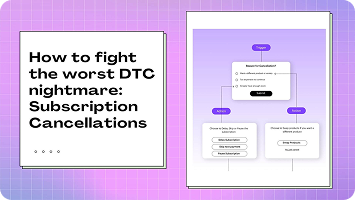
20. Build the cancellation offer for "I only wanted the BFCM deal." One of your cancellation reasons in December and January will effectively be this, whether or not you've written it as an option. Add it explicitly — a named reason can be answered, a vague one can't.
On the offer page, acknowledge it directly: thanks for joining us during BFCM. Then pair that with something worth more than the discount they're leaving for — a full-size free gift, or an extra percentage off the next two or more orders, which spreads the incentive across exactly the window where this cohort leaves. Decide this in October; a save offer designed under pressure in January will just be a discount. See cancellation flows for Shopify subscription brands.
Run the December renewal check — first charges, failed payments, fulfilment. Then in January, isolate the BFCM cohort, measure 0-day churn for that group, and compare it against a September or October control. If the BFCM cohort runs materially worse, the discount was too deep. That number sets next year's depth.
Written for subscription decisions, not generic ecommerce copy. Replace the bracketed sections with your own data.
When is BFCM 2026?
Black Friday is Friday 27 November 2026 and Cyber Monday is Monday 30 November 2026.
When should I start preparing for BFCM?
6–8 weeks for a subscription brand. Selling plan changes need the longest lead time because they affect live subscription contracts.
What's different about a BFCM checklist for subscription brands?
Standard checklists cover inventory, site performance and fulfilment. Subscription brands also decide whether the discount recurs, configure billing cycle minimums, manage what existing subscribers see during the sale, run subscriber-only campaigns, and plan for the December renewal wave.
How do I run a BFCM offer for existing subscribers only?
Use a time-boxed campaign targeted at your active subscriber segment and merchandise it inside the customer portal. A defined start and end time makes the exclusivity and the deadline verifiable rather than implied.
Can I win back cancelled subscribers during BFCM?
Yes — it's the best reactivation window of the year, because lapsed subscribers are already shopping and already know the product. Make the comeback offer different from your public sale, or there's no reason for them to resubscribe rather than buy once.
How do I stop the BFCM cohort cancelling after the first order?
Build the retention plays before December. A mystery reward conditioned on the BFCM cohort fires when they open the portal to cancel, and a cancellation offer written for the "I only wanted the BFCM deal" reason gives you something to answer them with.
How do I stop people subscribing just for the discount?
Set a minimum number of billing cycles on the BFCM selling plan, taper the discount after the first order or two, or use a prepaid plan that collects for multiple deliveries upfront.
What should I measure after BFCM?
0-day churn for the BFCM cohort against a non-BFCM control, split by voluntary and involuntary cancellation. Read it in January, after the first renewal has run.