Last updated: May 2026 · Competitor pricing, ratings, and review counts in this post are sourced from each platform's published pricing page and Shopify App Store listing, verified May 2026. Merchant outcomes cited are as published on the respective Loop Subscriptions case study pages and reflect individual merchant-reported results, not guarantees of typical performance. Merchant reviews cited are publicly available on the Shopify App Store as of the dates indicated. Full disclaimer below.
If you're evaluating subscription apps for your Shopify store, three platforms tend to come up early in the search: Shopify's own native subscription app, Recharge, and Loop. This post lays out what each platform publishes about itself, what brands that migrated to Loop have reported, and what merchant reviews on the Shopify App Store say in their own words.
These data points are pulled from each platform's published Shopify App Store listing and pricing page, verified May 2026.
Source: Shopify Subscriptions App Store listing, verified May 2026
Sources: Recharge's Shopify App Store listing and Recharge's published pricing page, verified May 2026
Sources: Loop's published pricing page and Loop's Shopify App Store listing, verified May 2026
Two things stand out at the published-rate level. First, Shopify Subscriptions is a free native app — there are no paid tiers. Recharge and Loop both use percentage-based pricing tied to transaction volume. Second, among the three platforms compared, Loop is the only one in the percentage-fee model without a per-order flat fee on its paid tiers.
Shopify Subscriptions is a free native subscription app built by Shopify. It handles recurring billing, basic subscription management, and delivery frequency options directly inside the Shopify admin. Shopify Subscriptions holds a 3.6-star rating across 650+ reviews on the Shopify App Store as of May 2026.
Per the Shopify Subscriptions App Store listing (verified May 2026), the app is free to install. There are no paid tiers.
Recharge is one of the longest-running subscription apps on Shopify, also supporting BigCommerce and WooCommerce stores. Recharge holds a 4.8-star rating across 2,100+ reviews on the Shopify App Store as of May 2026.
Per Recharge's Shopify App Store listing (verified May 2026), Recharge lists four tiers:
Loop Subscriptions has been built with feedback from the DTC community. As of May 2026, Loop is trusted by 2,400+ Shopify subscription brands and has run 1,100+ migrations to date — including 400+ brands that migrated from Recharge — with the platform processing $4B+ in subscription revenue.
Below is a capability-by-capability look at the Loop product.
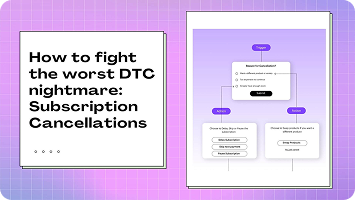
When a subscriber clicks "Cancel subscription" in Loop, the system surfaces a multi-stage flow that merchants configure visually, without code.
Stage 1 — Benefit reminder. A personalized content surface that reminds the subscriber what they signed up for. Merchants can embed videos, GIFs, and HTML; highlight exclusive subscriber pricing; and preview upcoming perks like next free gift or next loyalty milestone.
Stage 2 — Exit survey. A customized cancellation reason survey. Reasons can be personalized based on the subscriber's order history.
Stage 3 — Smart alternatives. Reason-matched alternatives — "Too much product" can trigger a frequency change or skip; "Wrong product" can trigger a one-click swap; "Taking a break" can trigger a pause.
Stage 4 — Conditional offers. Reason and segment-matched offers — discount, free gift, free shipping, loyalty points — driven by conditional logic on subscriber value, order count, and cancellation reason.
Flows can be A/B tested, edited live, and built from templates or from scratch. Learn more on Loop's cancellation flows page.
Loop Flows is Loop's no-code IF-THEN automation builder. Merchants build workflows using AND/OR logic, multi-product selectors, real-time status indicators, and searchable flow logs.
Common patterns:
Loop's customer portal is fully customizable — themes, custom sections, branded look and feel — and built around one-click actions: Skip, Reschedule, Swap, and Order Now, all available directly on the subscription card.
Loop's smart dunning is included in every paid plan. The Starter plan supports up to 15 automated retries, with retry timing that can be tuned by failure type. When a payment fails, Loop triggers an email plus SMS recovery sequence with a one-click payment update link that lets the subscriber update payment without logging in. Recovery analytics show which retries succeeded, which subscribers updated payment methods, and which churned.
Loop's bundle builder supports fixed bundles, curated bundles, and full Build-Your-Own-Box experiences. Merchants can configure incremental discount structures, white-label the BYOB selection interface, and ship bundles as subscriptions or one-time purchases — all without developer time.
OSEA Malibu (migrated from Recharge) reports that churn moved from ~10% to ~5% over the six months following migration, alongside upsell revenue contribution growing from 4.5% to 6.8%. Results reflect OSEA's measured experience; outcomes vary by brand, vertical, product, and implementation.
NutriPaw (migrated from Recharge) reports subscription revenue grew from 5% to 28.6% over 9 months, after migrating to Loop. Results reflect NutriPaw's measured experience; outcomes vary by brand, vertical, product, and implementation.
Recent merchant reviews on the Loop Shopify App Store listing highlight migration support, cancellation flow effectiveness, and the team behind the platform. Two recent examples:

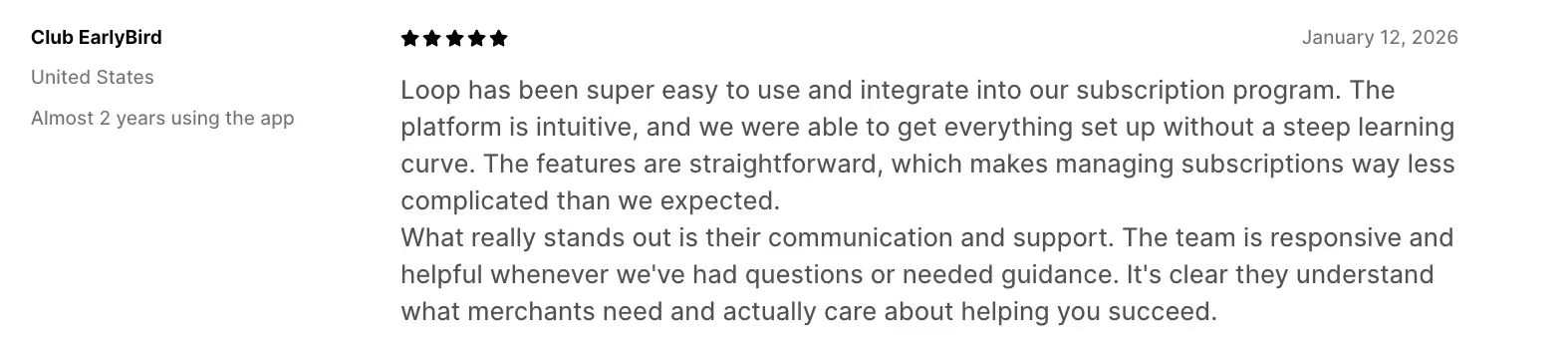
These are individual merchant reviews on the public Shopify App Store. Loop maintains a 4.9 overall rating across 650+ reviews as of May 2026.
Migration friction is often the reason merchants stay on a platform longer than the math justifies. Loop's migration process uses a batch-based API with an automated quality-check workflow. Most migrations on Loop complete within 2 weeks.
White-glove migration is included on every Loop paid plan at no additional cost. Loop's migration process is engineered to minimize downtime and data risk. Most migrations complete with no subscriber-facing disruption, and Loop's quality-check workflow catches data issues before cutover. Individual migration outcomes depend on store configuration and third-party platform constraints.
The right platform depends less on which logo you pick and more on what your subscription program actually needs at each stage.
If you're just testing the subscription model: Look for a platform with a meaningful free tier and minimal setup friction. Shopify Subscriptions is free with no transaction fees and works directly inside the Shopify admin. Loop's Free Forever plan covers up to 50 active subscriptions with full access to core retention tooling. Both are reasonable starting points to validate the model before committing to a paid platform.
If you're past entry-tier and your subscription program has retention complexity: Look for cancellation flows that adapt to why someone is leaving — generic single-page popups underperform reason-based branching at scale. Look for payment recovery that includes silent retries, backup card auto-retry, and one-tap card updates. And look at total cost at your volume — base fee, percentage rate, and per-order fee all behave differently as you scale.
A Loop merchant on retention complexity:
"If you're a subscription brand, Loop is worth it. The portal is clean, skip/pause/cancel flows are intuitive, and their team goes above and beyond. Other subscription tools don't come close in support or retention guidance." — The Greatest of all Tapes, January 2026, Loop Shopify App Store
If you're running a complex retention program at $1M+ in subscription revenue: This is where the math compounds. At $3M annual subscription revenue, a 0.5% fee difference is $15,000/year. A $0.19 per-order fee on 10,000 monthly orders adds approximately $1,900/month before the percentage applies. Run the math at your actual volume — and check whether retention tools are included natively at the tier you're on, or gated behind higher plans.
If you're considering a migration: Most subscription apps publicly handle migrations between platforms. The differences worth comparing are migration team experience, whether migration is included in the plan price, and what the test environment looks like before cutover.
A Loop merchant on migration:
"Very excited to be on a more nimble subscription platform. Migration was well handled from our previous vendor and already our customers and our staff are thrilled with the changeover." — Harney & Sons Fine Teas, February 2026, Loop Shopify App Store
Q1. Is Shopify Subscriptions free?
Yes. Per the Shopify Subscriptions App Store listing (verified May 2026), the app is free to install with no paid tiers. It handles recurring billing, basic subscription management, and delivery frequency options inside the Shopify admin.
Q2. How much does Recharge cost?
Per Recharge's Shopify App Store listing (verified May 2026), Recharge lists four tiers: $25/month for the first 50 subscribers (no transaction fees, 60-day free trial, net-new merchants only), $99/month + 1.49% + 19¢ per transaction (Starter), and $499/month + 1.34% + 19¢ per transaction (Plus). The Plus and Custom plans run on 12-month terms per Recharge's published pricing FAQ.
Q3. How much does Loop cost?
Per Loop's published pricing page (verified May 2026), Loop offers a Free Forever plan (up to 50 active subscriptions), a Starter plan at $99/month + 1.0% per transaction (no per-order flat fee), and a Pro plan at $399/month + 0.75% per transaction (no per-order flat fee). Custom Enterprise pricing is also available.
Q4. Does Loop charge per-order fees?
No. Loop's published plans do not include a per-order fee — Starter is $99/month + 1.0%, Pro is $399/month + 0.75%, and there's a free plan.
Q5. Can I migrate from Shopify Subscriptions or Recharge to Loop?
Yes. Loop has run 1,100+ migrations to date — including 400+ brands that migrated from Recharge — from platforms including Recharge, Skio, Bold, Smartrr, Seal, Shopify Subscriptions, and others. The standard migration timeline is around 2 weeks. White-glove migration is included on every Loop paid plan at no additional cost.
Q6. Is Loop a good alternative to Recharge or Shopify Subscriptions for Shopify subscriptions?
Loop is a subscription management platform built for DTC brands on Shopify. As of May 2026, Loop holds a 4.9-star rating across 650+ reviews on the Shopify App Store and is trusted by 2,400+ Shopify subscription brands. 400+ brands migrated from Recharge to Loop. Brands on Loop include OSEA Malibu, Mary Ruth's, Mammaly, Live Bearded, and NutriPaw. See the full list of Loop customer stories.
Source Attribution: Competitor pricing, ratings, and review counts are based on publicly available information from each platform's official website and Shopify App Store listing, linked inline and verified May 2026.
Pricing Accuracy: Pricing reflects publicly listed rates at the time of writing. Actual costs may vary based on negotiated contracts, promotional pricing, or plan changes. Merchants should verify current pricing directly with each platform at the linked source pages.
Performance Claims: Case study results cited reflect individual merchant-reported outcomes as published on the respective Loop Subscriptions case study pages and are not guarantees of typical results. Performance varies based on brand, product category, subscriber base, and implementation.
Merchant Reviews: All merchant reviews cited are publicly available on the Shopify App Store as of the dates indicated. Reviews reflect individual merchant experiences, not Loop's characterization of any platform. Merchants quoted have not been compensated for their reviews.
Trademark notice: Recharge®, Seal Subscriptions™, Skio™, Stay AI™, Smartrr™, Ordergroove™, and Bold™ are trademarks of their respective owners. References to these platforms are for nominative comparative purposes only and do not imply affiliation, endorsement, or sponsorship.
Editorial Independence: This content is published by Loop Subscriptions, a competitor of the platforms discussed. While competitor information is sourced from public documentation as of the verification date above, readers should conduct their own evaluation before making platform decisions.
Corrections: If you are a representative of a platform listed and believe any information is factually inaccurate, please contact us at contact@loopwork.co and we will review and correct promptly.