
Loop Pro
$399/mo + 0.75%
Base
$399
Variable
$3,750
Total at 10k / $50 AOV
$4,149


Last updated: May 2026 · Competitor pricing, features, ratings, and review counts in this post are sourced from each platform's published pricing page, Shopify App Store listing, and (where cited) support documentation. Merchant outcomes cited are as published on the respective Loop Subscriptions case study pages and reflect individual merchant-reported results, not guarantees of typical performance. Full disclaimer below
The right platform depends less on which logo you pick and more on what your subscription program actually needs at each stage. Here's how to think about it:
What matters is having the basic mechanics work without breaking the cart — a subscription widget that lets customers subscribe at checkout, a customer portal where they can skip or cancel, and a way to recover failed payments. These should be available on the entry-tier plan of any subscription app, not gated behind premium tiers.
This is where automated dunning starts to matter. Failed payments compound — at scale, even a 5% failure rate on 10,000 orders is 500 subscribers per month at risk. You want a platform where you can configure retry logic, set silent retries early, and offer one-click card updates without forcing subscribers to log in. The same applies to cancellation flows — generic single-page popups underperform reason-based branching at scale. At this stage, look at whether these capabilities are included natively or gated behind higher tiers.
The platform decision becomes about feature scope at your tier and total cost at your volume. Compare what's included natively versus what requires add-ons or higher plans. Run the math at your specific order volume — base fee, percentage, and per-order fee all behave differently at scale. A 0.5% rate difference is meaningful at $3M in annual subscription revenue.
Storefront APIs, dedicated CSMs, headless support, and volume-based pricing are standard at this tier across most platforms. The differentiation usually comes from implementation support, the migration team's experience with complex setups, and how the platform integrates with your existing stack (Klaviyo, Attentive, your data warehouse).
Start with a published-rate cost model at your actual volume. See Bold vs Recharge vs Loop pricing breakdown for the math at multiple volumes.
Most subscription apps publicly handle migrations between platforms. The differences worth comparing are migration team experience, whether migration is included in the plan price, and what the test environment looks like before cutover.
For complex migrations — multiple payment gateways, large subscriber bases, or heavily customized setups — working with an experienced migration partner like Total Commerce alongside your app's team can de-risk the cutover and keep subscriber data intact end to end.
The most honest comparison is platform fees at a defined volume. Here's what each platform's top published tier costs at 10,000 subscription orders per month with a $50 average order value (i.e., $500,000 in monthly subscription GMV), based on published rates verified May 2026:
Loop Pro and Bold Ultimate Retention land within ~$750/month of each other. Recharge Plus comes out roughly double either one at this volume — the structural reason is the combined per-percentage and per-order fee that compounds with growth.
Note: Bold's Scale plan ($74.99/month + 0.9%) is a lower-priced mid-tier option that lacks ProsperStack-powered cancellation prevention but offers the same 0.9% transaction rate. At 10K orders at $50 AOV, Scale would run approximately $4,574.99/month — between Loop Pro ($4,149) and Bold Ultimate Retention ($4,899.99). Brands prioritizing cost over advanced churn-prevention tooling may find Scale more relevant than Ultimate Retention.
For the entry-tier math at 1,000 orders, see Bold vs Recharge vs Loop pricing.
(Sources: Recharge pricing page, verified May 2026)
Recharge holds a 4.8 overall rating with 2,100+ Shopify App Store reviews as of May 2026.
(Sources: Shopify App Store listing and Bold Commerce pricing page, verified May 2026)
Bold holds a 4.2 overall rating with 360+ Shopify App Store reviews as of May 2026.
Loop launched in 2021. As of May 2026, Loop holds a 4.9-star rating with 650+ Shopify App Store reviews and is trusted by 2,400+ Shopify subscription brands. Loop is positioned as a top Recharge alternative and has run 1,100+ migrations to date — including 400+ brands that migrated from Recharge — with the platform processing $4B+ in subscription revenue. See the Loop migration page for details.
(Sources: Loop pricing page and Shopify App Store listing, verified May 2026)
No per-order flat fee on any paid plan.
Starter: Fixed & Custom Bundles · Smart dunning · Branded portal & upsell · Personalized cancellation flows · Price & shipping rules · 1-click customer actions.
Pro — All Starter features plus: Dedicated CSM + Slack Support · Prepaid · Themes · Subscriber rewards · Multilingual · Smart Inventory · Bulk Actions · User Permissions · Custom mail domain · API & Webhooks.
Enterprise: Tailored plan · Volume discounts · Custom development · Direct line to our founders · Dedicated support channel with phone and chat support.
See Loop's pricing page for the full feature list.
Gamified subscriber journeys via Loop Flows — milestone rewards, mystery rewards, surprise gifts on specific orders, progress banners ("X orders away from free merch"). Configurable without developer involvement.
No-code bundle builder — fixed bundles, build-your-own-bundle, range-based "buy more, save more" with multi-variant selection. Usable as one-time or subscription offers. Lilac St. reports a 72.7% increase in subscription revenue within 11 months of implementing Loop's bundle setup, with total subscriptions activated growing 55.2%.
Configurable smart dunning — retry logic on failed and about-to-fail cards, auto-pause/cancel rules after specified attempts, exportable at-risk subscriber lists for Klaviyo or Attentive automation.
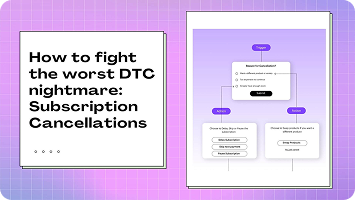
Branched cancellation flows — embed video, GIF, or HTML in the portal; branch alternative offers (skip, swap, pause, discount) by cancellation reason; review save rate by reason and segment. BEAM Supplements reports their cancellation rate moved from 10.09% to 7.83% — a ~30% reduction — within three weeks of adding a founder video message to their cancellation flow.
Livingood Daily migrated approximately 130,000 subscribers from Recharge to Loop in 22 days. The team reports their churn rate moved from ~10% to ~2.26% after configuring their retention setup on Loop — segmented exit surveys, a founder-recorded video inside the cancellation flow, and milestone-based reward flows for subscribers reaching their second order.
OSEA Malibu (also migrated from Recharge) reports their churn rate moved from ~10% to ~5% over the six months following migration, alongside upsell revenue growing from 4.5% to 6.8%.
Live Bearded (migrated from Bold) reports subscription revenue grew from 5% to 20% of total revenue in the nine months following the migration, with average churn over six months at 3%.
These are each individual merchant outcomes; results vary by brand, category, and platform configuration.
Migration friction is often the reason merchants stay on a platform longer than the math justifies. The basic process is similar across providers: API-based subscription data transfer, payment token migration, theme integration, test migration, then cutover. Loop's migration process uses an automated quality-check workflow, with the technical data transfer, and full migrations typically completing in 2 weeks of planning and testing. Loop has run 1,100+ migrations to date, with white-glove migration included on every paid plan.
Q1. Is Loop a good alternative to Recharge or Bold for Shopify subscriptions?
Loop is a Shopify-native subscription management platform built for DTC brands. As of May 2026, Loop holds a 4.9-star rating with 650+ Shopify App Store reviews and is trusted by 2,400+ Shopify subscription brands. Brands on Loop include OSEA Malibu, Mary Ruth's, Mammaly, Four Sigmatic, Live Bearded, Livingood Daily, and NutriPaw. See the full list of Loop customer stories.
Q2. How long does migration from Recharge or Bold to Loop take?
Most Loop migrations complete within 2 weeks. Livingood Daily migrated ~130k subscribers in approximately 3 weeks; OSEA Malibu migrated in approximately 2 weeks. Timelines vary based on subscriber volume, discount complexity, and custom integrations.
Q3. How does Loop help reduce subscription churn?
Loop's cancellation flows personalize the save journey using order count, lifetime value, product, and cancellation reason as segmentation triggers — so a high-LTV subscriber sees a different offer than a first-order subscriber. Verified merchant outcomes include OSEA Malibu (reports churn moved from ~10% to ~5% over six months) and Livingood Daily (reports churn moved from ~10% to ~2.26%). Results reflect each merchant's measured experience; outcomes vary by brand, vertical, product, and implementation.
Q5. Is the migration to Loop free?
Yes. Loop's white-glove migration is included on every paid plan at no additional cost. Every migration includes a dedicated migration manager, a shared Slack channel, a pre-migration test environment, and post-launch hypercare.
Q6. How does Loop handle failed payment recovery?
Loop's smart dunning is included on every paid plan. Up to 15 retries are timed by failure type — soft declines (insufficient funds) retry across paydays, hard declines (expired cards) auto-skip. Failed-payment emails use one-click Quick Action links, and a backup card can auto-charge when the primary fails.
Q7. What kind of support does Loop offer?
Loop Pro plans include a dedicated Customer Success Manager and a shared Slack channel. As of May 2026, Loop holds a 4.9-star rating across 650+ Shopify App Store reviews.
Disclaimer
Source Attribution: Competitor feature descriptions are based on publicly available information from each platform's official website, support documentation, help center, and Shopify App Store listing, verified May 2026. Features and pricing may have changed since publication. This comparison is refreshed quarterly.
Pricing Accuracy: Pricing reflects publicly listed rates at the time of writing. Actual costs may vary based on negotiated contracts, promotional pricing, or plan changes. Merchants should verify current pricing directly with each platform.
Performance Claims: Case study results cited reflect individual merchant-reported outcomes and are not guarantees of typical results. Performance varies based on brand, product category, subscriber base, and implementation.
Editorial Independence: This content is published by Loop Subscriptions. While competitor information is sourced from public documentation, readers should conduct their own evaluation before making platform decisions.
Corrections: If you are a representative of a platform listed and believe any information is factually inaccurate, please contact us at contact@loopwork.co and we will review and correct promptly.