.avif)

She subscribed eleven months ago. She hasn't missed a delivery. She hasn't contacted support. She hasn't thought about your brand in weeks. And next Tuesday, she'll churn—not because she decided to leave, but because her credit card expired and nobody told her.
At the same time, another subscriber—one who loves your product—is sitting on three unopened boxes. She doesn't need to cancel. She needs to skip a delivery. But the only buttons she can find are "Keep subscription" and "Cancel." So she cancels.
Two subscribers. Two completely different problems. Both gone by Tuesday.
This is the subscription churn problem hiding in plain sight. PYMNTS research found that subscription businesses lose an average of 9% of their annual revenue to failed payments alone. Recurly's data projects that failed payments could cost the subscription industry more than $129 billion. And that's just involuntary churn—the silent leak. Layer voluntary churn on top, and the average ecommerce subscription brand faces 5–10% monthly churn.
But here's the flip side. Bain & Company's research shows that increasing customer retention by just 5% can boost profits by 25–95%. And acquiring a new subscriber costs 5–25x more than retaining an existing one. Every subscriber you save—whether from a failed payment, a premature cancellation, or a moment of product fatigue—compounds into meaningful revenue over time.
This is the complete guide to reducing subscription churn on Shopify in 2026. Not a single tactic. Not a quick fix. A seven-layer retention framework that addresses every type of churn, at every stage of the subscriber journey, using Loop Subscriptions features built specifically for DTC brands on Shopify.
Before you can reduce churn, you need to understand what you're fighting. Subscription churn isn't one problem—it's three, and each requires a different solution.
Involuntary churn happens when subscribers are lost due to payment failures—expired cards, insufficient funds, bank declines, or processing errors. The subscriber didn't choose to leave. Their payment just failed. PYMNTS found that only 17% of subscription-focused firms actively track failed payments—despite those failures costing 9% of annual revenue. In 4 out of 5 cases, payment failures stem from system frictions like false declines and processing issues, not customers choosing to stop paying.
Voluntary churn—passive is the subscriber who doesn't hate your product but cancels because of solvable friction: too much product stacking up, the wrong delivery timing, product fatigue, or needing a temporary break. Chargebee's 2025 consumer research found that 78% of consumers demand pause or swap options from their subscriptions, and 82% are more likely to subscribe when cancellation is easy. These subscribers don't need convincing—they need flexibility.
Voluntary churn—active is the subscriber who has decided to leave: the product is too expensive, it didn't meet expectations, or their needs have fundamentally changed. This is where cancellation flows intercept the cancel click and present personalized alternatives. Industry data from retention platforms like Churnkey suggests that well-designed cancellation flows can save 20–40% of at-risk revenue, depending on how precisely the save offers match the specific cancellation reasons.
The mistake most brands make is treating churn as a single problem and deploying a single solution. A cancellation flow won't fix expired cards. Payment retries won't help a subscriber drowning in overstock. And neither will reach the subscriber who cancelled six months ago. Effective churn reduction means building systems for all three types—simultaneously.
Reducing subscription churn on Shopify isn't about one feature or one flow. It's about building a retention ecosystem with seven interconnected layers, each addressing a different stage of the subscriber journey and a different type of churn.
The compounding effect is what makes this framework powerful. A subscriber whose failed payment is automatically retried and recovered at Layer 1 never reaches the cancellation flow at Layer 5. A subscriber who uses the skip button at Layer 3 never sees the exit survey. A subscriber earning gamified rewards at Layer 4 stays engaged and never considers leaving. Each layer reduces the load on the next.
Let's break down each layer.
Involuntary churn is the most fixable type of subscriber loss—and the most overlooked. These subscribers didn't want to leave. Their payment just failed.
Loop's dunning management addresses involuntary churn through multiple mechanisms working together.
.png)
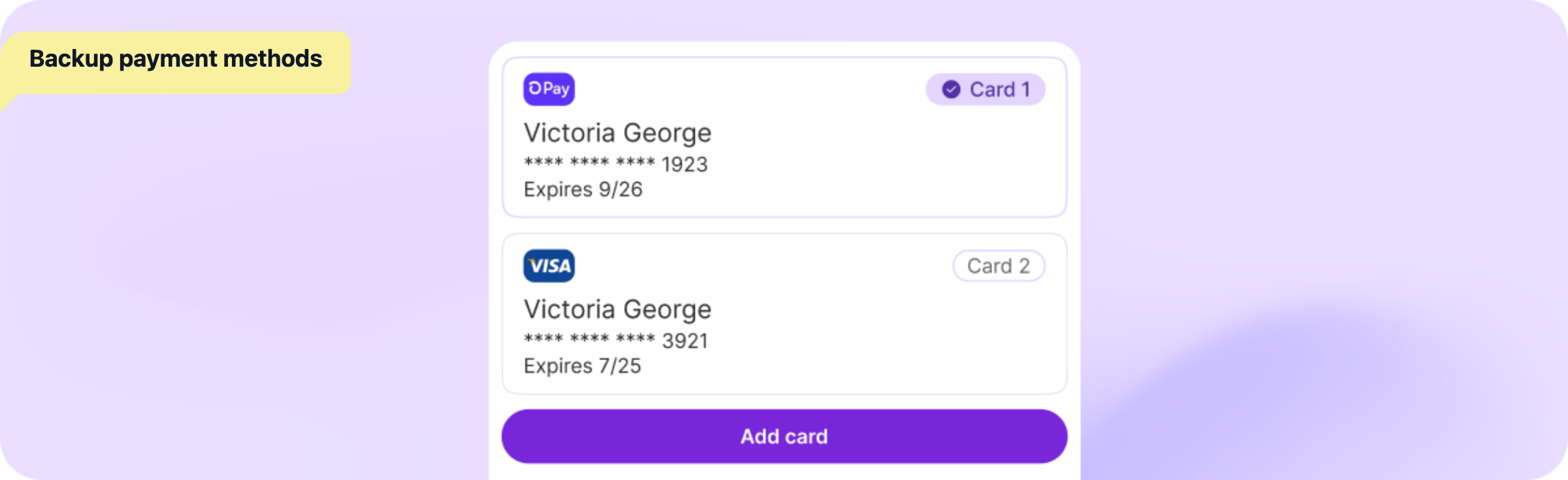

Intelligent payment retries. Loop supports up to 15 automatic retries, spacing them strategically rather than hammering the same card repeatedly. Many payment failures are temporary—insufficient funds on Tuesday might clear by Friday. Recurly's data shows their merchants recovered over $1.2 billion in revenue through intelligent retry and recovery tools in a single year.
Backup payment methods. When the primary card fails, Loop automatically charges a secondary card on file—no subscriber action required. The subscription continues seamlessly.
Pre-dunning notifications. The most proactive approach: alert subscribers when their card is about to expire before the charge attempt fails. A simple email paired with a one-click Quick Action link to update payment prevents the failure from ever occurring.
Recovery communications with Quick Actions. When payment fails, Loop's Quick Actions—magic links embedded in emails and SMS—let subscribers update their payment method in one click. No portal navigation, no login hunting. One tap, card updated, subscription saved.
The best failed payment is one that never fails. Pre-dunning sits upstream of your dunning system, catching issues before they trigger the retry cycle.
Card expiration alerts notify subscribers 7–14 days before their card expires, with a one-click update link. Bank authorization issues can be surfaced early through payment processor webhooks, letting you reach out before the charge date.
SMS tends to outperform email for urgent payment update requests—Attentive's research shows significantly higher conversion rates for time-sensitive transactional messages sent via text. Loop integrates with both Klaviyo and Attentive to trigger pre-dunning communications through whichever channel the subscriber is most responsive to.
This is the layer that prevents the largest share of voluntary churn. Recurly's data shows that 25% of would-be churners choose to pause instead of cancel when the option simply exists. Chargebee found that 58% of consumers have paused a subscription instead of cancelling when given the option. And Recurly reports that paused subscribers have generated over $200 million in re-subscription revenue, with the vast majority resuming within months.
Loop's customer portal puts four flexibility levers front and center on every subscription card:
Pause — One tap, select a duration (1–3 months), and the subscription enters a paused state. Done in three seconds. The subscriber who needs a break doesn't cancel—they pause. And they come back.
Skip — One tap, and the next delivery moves out. The subscription stays active. Every skip is a cancellation prevented.
Swap — Browse alternatives, select a new product. Same billing cycle, same discount—different product. When paired with personalized recommendations, swaps become discovery moments that deepen the subscriber's connection to your catalog.
Reschedule — A simple calendar picker changes the next delivery date. Ties into Loop's anchor day functionality for consistent delivery scheduling.
The portal's design determines whether these features reduce churn or sit unused. When subscribers arrive, every action should be visible and accessible in one tap—skip, reschedule, swap, order now. No phone calls. No support tickets. Self-service flexibility in under three seconds.
For brands with larger catalogs, Loop's bundle builder adds another flexibility dimension. Subscribers who curate personalized subscription boxes—hand-picking five products for their monthly delivery—are far more committed than single-product subscribers. They've invested time in curation, explored the catalog, and built a routine. Cancellation means losing all of that.
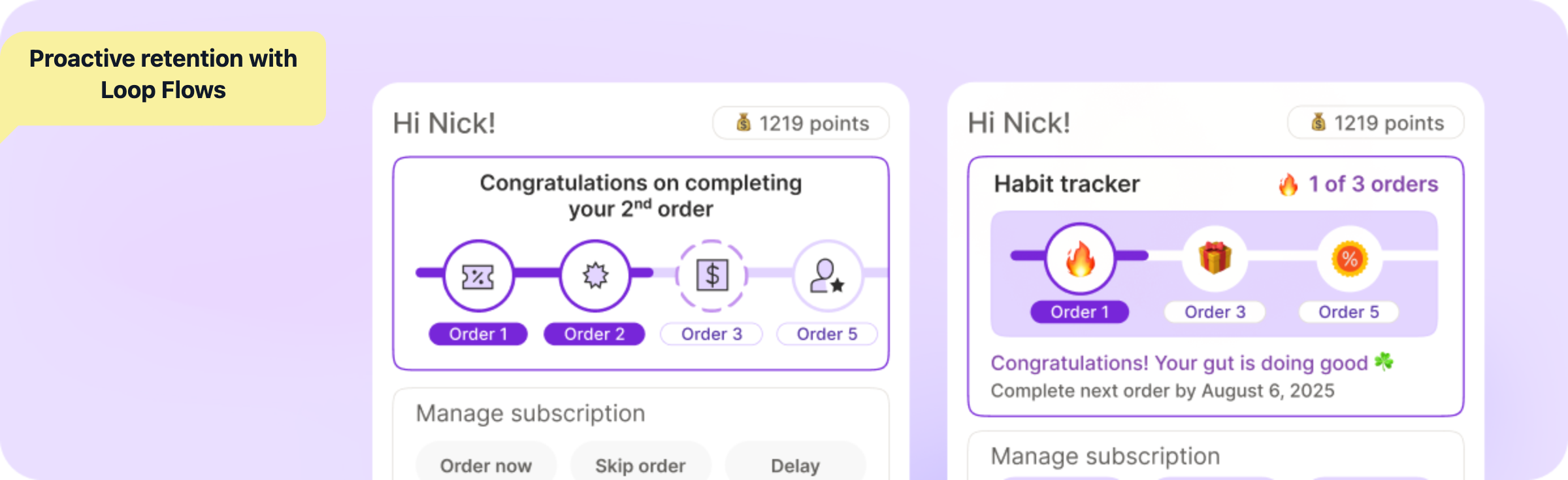

Loop Flows let you build automated reward sequences that keep subscribers engaged throughout their journey—mystery rewards on the 5th order, loyalty tier upgrades on the 10th, free gifts on the 15th.
A subscriber who sees "You're 1 order away from a FREE gift!" on their portal isn't just deciding whether to keep subscribing—they're deciding whether to abandon progress they've already invested in. This taps into the endowment effect and sunk cost psychology in ways that straightforward discounts can't match.
Personalized product recommendations through Loop's upsell engine compound this effect. A prompt like "Pairs perfectly with your protein—subscribers on their 5th+ order get 15% off" drives higher AOV while deepening investment. The more products in a subscription, the higher the switching costs, the lower the churn.
Gamification also pairs well with flexibility features. Rewarding subscribers for using skip or pause instead of cancelling—"Thanks for managing your subscription! Here's 10% off your next order"—trains the behavior you want. It teaches subscribers that flexibility features exist and that using them is rewarded.
When a subscriber clicks "Cancel subscription," a cancellation flow activates—a multi-step journey designed to understand why they're leaving and present the right alternative.
Step 1: The benefits reminder. The first screen reminds subscribers what they'll lose—their discount, free shipping, accumulated loyalty points, and upcoming rewards. Loss aversion means people feel losses roughly twice as strongly as equivalent gains. If your brand uses gamified rewards, a subscriber who sees "You're 1 order away from a FREE gift!" is far less likely to proceed.
Step 2: The exit survey. The next screen captures the reason behind cancellation intent. Each reason maps to a specific save action. Every response feeds your subscription analytics, helping you spot patterns—if 40% of cancellations cite "too much product," that's a signal to adjust your default delivery frequency.
Step 3: The personalized save offer. Based on the exit survey reason, Loop presents a tailored alternative:
Loop's cancellation flows support 20+ segmentation attributes, meaning a first-time subscriber sees a different flow than a loyal subscriber on their 15th order. The save offer that works for a price-sensitive new subscriber is different from what resonates with a long-term customer experiencing product fatigue.
Step 4: The graceful exit. For subscribers who decline all offers, the final screen asks: "Are you sure?" After cancellation, a reactivation path—"Changed your mind? Reactivate anytime"—paired with one-click magic links creates a frictionless path back.
The more products a subscriber has in their subscription, the harder it is to leave. Personalized recommendations in the customer portal turn every portal visit into a potential AOV increase—"Recommended for you: Creatine Monohydrate—pairs perfectly with your protein. Subscribers on their 5th+ order get 15% off. [Add to Next Order →]"
Bundle subscriptions take this further. A subscriber who has hand-picked five products for their monthly box has invested time in curation. That's exactly the kind of switching cost that drives long-term retention.
Loop's selling plans also support prepaid subscriptions—a powerful retention mechanism. A 3-month prepaid plan at a deeper discount locks in revenue upfront and removes the monthly "should I keep this?" decision. Prepaid subscribers have dramatically lower involuntary churn because the payment has already been processed.
Even the best retention stack won't save everyone. For subscribers who do cancel, win-back campaigns are your final recovery lever. Recurly's 2026 State of Subscriptions data shows that 1 in 4 new subscriptions now come from former customers—proving that churned subscribers are a high-value re-acquisition audience.
Loop integrates with Klaviyo and Attentive to trigger win-back flows with Quick Action magic links—"We miss you! Come back for 25% off" with a one-click reactivation link. No portal navigation, no login hunting. Klaviyo's benchmark data shows that 45% of win-back email recipients engage with future communications, making these campaigns a long-tail revenue driver even when the immediate reactivation doesn't happen.
Multichannel win-back campaigns consistently outperform single-channel approaches. Subscribers who engage across both email and SMS convert at meaningfully higher rates than those reached through one channel alone.
Time your win-back sequences strategically: a light-touch "We miss you" at 7 days, a value-reminder at 14 days, a discount offer at 30 days, and a final "last chance" at 60 days. Each message should include a Quick Action magic link for one-click reactivation.
Subscription churn isn't inevitable. It's a system problem with a system solution.
The seven-layer framework works because it addresses every type of churn, at every stage, with the right intervention. Dunning catches failed payments. Pre-dunning prevents them. Flexibility gives subscribers alternatives to cancellation. Gamification keeps them invested. Cancellation flows intercept the exit and present the right offer. Upsell and bundles deepen commitment. And win-back campaigns recover those who do leave.
No single tactic eliminates churn. But these seven layers, working together, compound into the kind of retention improvement that transforms subscription economics—turning the 9% annual revenue leak into recovered growth.
Join 1,100+ brands processing $4B+ in subscription revenue with Loop Subscriptions. Book a demo to see how Loop's dunning management, cancellation flows, flexibility features, and retention tools work together—or start your free trial to begin building your seven-layer retention stack today.
Stop treating churn as a cost of doing business. Start treating it as a problem you can solve.
Q1. What is subscription churn and why does it matter for Shopify brands?
Subscription churn is the rate at which subscribers cancel or are lost from your subscription program. For ecommerce DTC brands, monthly churn typically ranges from 5–10%. Reducing churn is critical because Bain & Company's research shows that a 5% increase in retention can boost profits by 25–95%, and acquiring new subscribers costs 5–25x more than retaining existing ones.
Q2. What is the difference between involuntary and voluntary churn?
Involuntary churn happens when subscribers are lost due to failed payments—expired cards, insufficient funds, or processing errors. Voluntary churn happens when subscribers actively cancel. Involuntary churn typically represents 20–40% of total churn and is addressed through smart dunning and payment retries. Voluntary churn is addressed through subscription flexibility (pause, skip, swap) and personalized cancellation flows.
Q3. What are the most effective strategies to reduce subscription churn on Shopify?
The most effective approach uses a seven-layer framework: smart dunning for failed payment recovery, pre-dunning notifications, subscription flexibility (pause, skip, swap, reschedule) through a self-service customer portal, gamified rewards and milestone sequences, personalized cancellation flows with reason-based save offers, upsell and cross-sell to increase switching costs, and win-back campaigns for churned subscribers.
Q4. How much can a cancellation flow reduce churn?
Brands starting with cancellation flows typically see 10–15% save rates. With personalized reason-based offers, that rises to 20–30%. Advanced flows with escalating incentives, gamification, and multiple offer types push rates to 35–40%. The key variable is how precisely your save offers match the specific cancellation reasons.
Q5. Does offering pause and skip actually reduce churn, or just delay it?
The data shows it reduces churn. Recurly reports that 25% of would-be churners choose to pause instead of cancel when the option exists, and the vast majority of paused subscribers resume within months, generating over $200 million in re-subscription revenue. The key is measuring retention after save—track 30/60/90-day retention to ensure your flexibility features are preventing churn, not just delaying it.
Q6. How do I track and measure churn reduction on Shopify?
Track monthly churn rate (benchmark: 5–7% for ecommerce DTC), payment recovery rate (40–70%), cancellation flow save rate (20–40%), skip-to-cancel ratio (3–5 skips per cancellation), and pause return rate (60%+). Loop's analytics dashboard surfaces all of these metrics across Revenue, Cancellation, and Payments sections.