.avif)

Disclosure: This article is published by Loop Subscriptions, a Shopify subscription platform and direct competitor of the apps reviewed below. Competitor information is sourced from public documentation; verify directly with each platform.
There are 20+ subscription apps on Shopify. Most comparison posts list 10-15 and call it comprehensive. That's noise, not help.
Four platforms have dominated serious subscription commerce: Loop Subscriptions, Recharge, Stay AI, and Skio. As of April 2026, the landscape shifted — Recharge acquired Skio for $105 million, bringing two of the four under one roof. The Shopify subscription category effectively consolidated to two leading independents: Recharge (which now operates both its own product and Skio) and Loop, an independent subscription platform trusted by 2,400+ Shopify subscription brands processing $4B+ in subscription revenue.
Compare them on features and you'll get a spreadsheet where every cell says "yes" — billing, portals, analytics, dunning. The overlap is real. What separates them is how each one handles the moments where subscription revenue is actually won or lost — and those differences are structural, not cosmetic.
Not every feature matters equally. These four separate platforms you'll scale with from ones you'll outgrow.
This is where most subscription revenue is won or lost. Not acquisition — retention.
What to look for:
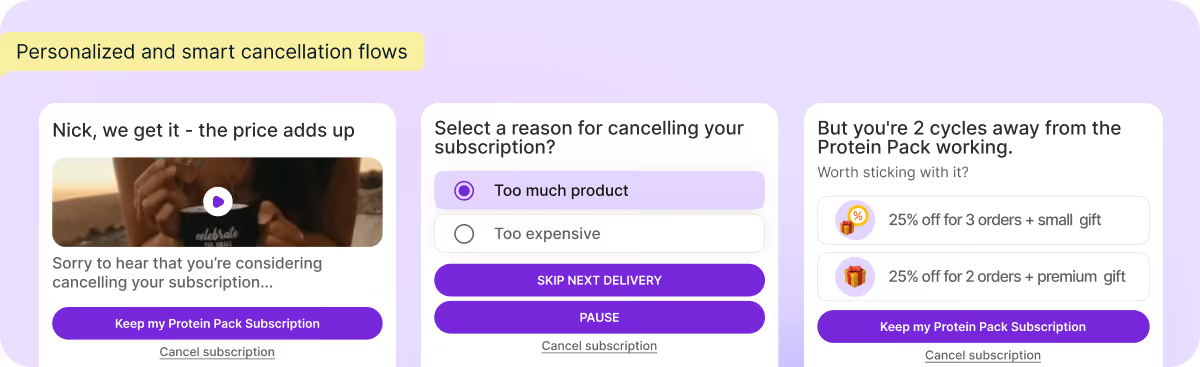
Personalized Engagement — Does the platform remind subscribers what they'll lose before asking why they're leaving? A subscriber who sees "You have 500 points ($5 value) that will expire" thinks twice.
Reason-Specific Alternatives — When someone says "I have too much product," does the platform offer to skip? When someone says "too expensive," does it offer a discount scaled to their value? Or does everyone see the same generic popup?
Offer Sequencing — Are discounts the first thing shown, or the last resort? Platforms that lead with discounts can train customers to cancel for savings; platforms that lead with education aim to preserve margin.
Granular Analytics — Can you see which page, which offer, which video actually converts? Or just an overall save rate number?
The math:
The difference: $120,000/year from the same cancellation volume.
Failed payments are commonly cited as a leading source of involuntary subscription churn, with industry references suggesting up to 40% of total churn at scale comes from payment failures.¹ This is involuntary churn, and platforms vary widely in how they address it.
What separates effective payment recovery:
.png)

.png)
.png)
Retry Depth — How many retry attempts? 3 versus 15 matters — some cards recover on the 1st of the month when paychecks hit.
Silent Recovery — Does every failed attempt trigger a "payment failed" email, or can early retries happen silently? Fewer notifications can mean less anxiety and fewer preemptive cancellations.
Backup Card Logic — If a subscriber has two cards on file, does the platform auto-retry the backup before entering dunning?
One-Tap Updates — Can subscribers update their card in one tap from the email? Or do they need to log in, navigate settings, find payment methods?
The math:
The difference: $96,000/year recovered.
Your customer portal is where subscribers decide to stay or leave. If basic actions require support tickets, friction goes up.
What matters for portal effectiveness:

.png)
.png)
Action Visibility — Can subscribers find Skip, Swap, Pause, and Cancel without hunting? Or are actions buried under multiple clicks?
Login Friction — Password required? OTP via SMS that doesn't arrive? Or magic link that works in one tap?
Personalized Upsells — Does the portal show relevant upsells — "Recommended for you: Creatine — pairs perfectly with your protein" — or is it purely subscription management?
The test: Open your portal on your phone. Try to skip your next order. If it takes more than 10 seconds, subscribers may end up calling support instead.
Pricing pages show monthly fees. They don't show what you'll pay at $1M, $3M, or $5M in subscription revenue.
What to calculate:
Pricing (per Loop's published pricing page, verified May 2026): Free plan available. Starter $99/month + 1.0%. Pro $399/month + 0.75%. No per-order fees.
Shopify rating: 4.9 stars (650+ reviews), verified May 2026.
Loop Subscriptions is a leading independent subscription platform on Shopify, trusted by 2,400+ subscription brands and processing $4B+ in subscription revenue. Loop has run 1,100+ migrations to date, including 400+ brands that migrated from Recharge. Following Recharge's acquisition of Skio in April 2026, Loop remains an independent subscription app — not owned by or affiliated with Recharge.
What recent merchant reviews highlight:
A merchant who recently migrated to Loop wrote on the Shopify App Store:

A long-tenured Loop merchant wrote in January 2026:
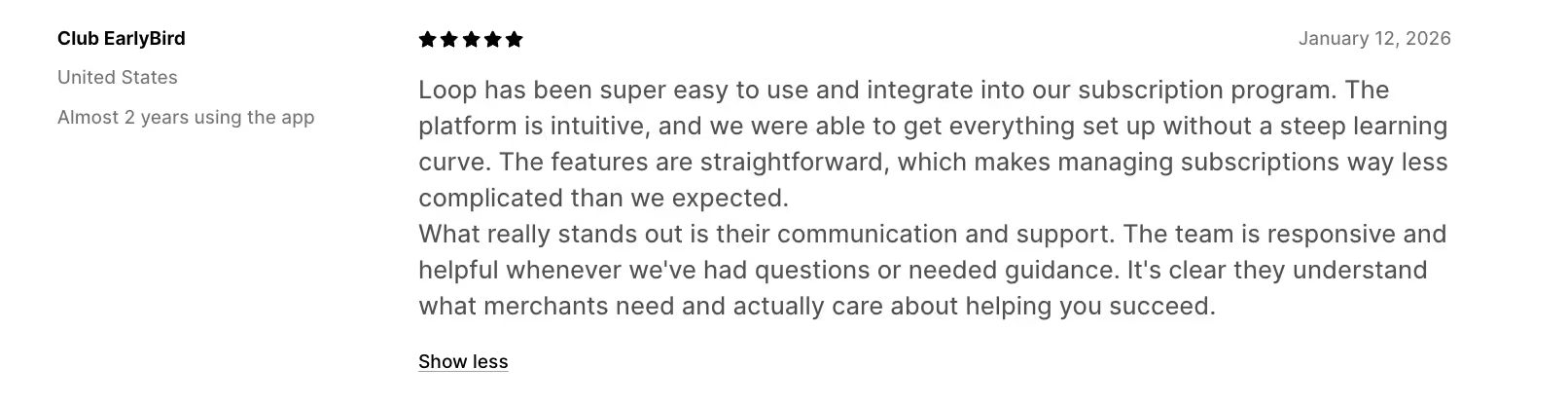
A subscription brand wrote in February 2026:

These are individual merchant reviews on the public Shopify App Store. Loop maintains a 4.9 overall rating across 650+ reviews as of May 2026.
Pricing (per Recharge's published pricing page and Recharge's support documentation, verified May 2026): 25-50 plan at $25/month (capped at 50 lifetime subscribers, net-new merchants only). Starter at $99/month + 1.49% + 19¢ per transaction (60-day free trial). Plus at $499/month + 1.34% + 19¢ per transaction (12-month term commitment). Custom: volume-based.
Shopify rating: 4.8 stars (2,100+ reviews), verified May 2026.
An established subscription platform on Shopify, powering 20,000+ merchants. On April 30, 2026, Recharge acquired Skio for $105 million in cash.
Pricing (per Stay AI's Shopify App Store listing, verified May 2026): $499/month + 1% + 19¢ per transaction. Stay AI also references additional pricing options on its published pricing page.
Shopify rating: 5.0 stars (140+ reviews), verified May 2026.
Stay AI is an AI-focused retention platform. It carries a 5.0-star rating on the Shopify App Store as of May 2026, with public reviews highlighting ease of setup, the visual flow builder, and responsiveness during onboarding. Merchants comparing Recharge and Stay AI can see how those platforms compare in the Stay AI vs Recharge vs Loop breakdown.
The right platform depends less on which logo you pick and more on what your subscription program actually needs at each stage. Here's how to think about it.
Cancellation flows that adapt to why someone is leaving. Generic single-page popups underperform reason-based branching at scale. A subscriber canceling for "too much product" should see a Skip option; someone canceling for "too expensive" should see an offer scaled to their value; someone switching products should see a Swap interface. The flow should adapt to the reason, not show the same screen to everyone.
A Loop merchant on this: "If you're a subscription brand, Loop is worth it. The portal is clean, skip/pause/cancel flows are intuitive, and their team goes above and beyond…” — The Greatest of all Tapes, January 2026, Loop Shopify App Store

Payment recovery that doesn't leak revenue. Failed payments are a leading source of involuntary churn at scale.¹ What matters: retry depth (3 versus 15 attempts), silent retries early so subscribers don't get spammed with "payment failed" emails, backup card auto-retry before dunning starts, and one-tap card updates that don't force a portal login.
A Loop merchant on this: "My sales from subscriptions have grown significantly since switching to Loop. This app is packed with features and flexibility that are included without an additional charge." — Supplement First, January 2026, Loop Shopify App Store

A customer portal subscribers can actually use. If skipping an order takes more than 10 seconds on mobile, subscribers will call support instead — and your churn math gets worse. Look for: clear Skip / Swap / Pause / Cancel buttons, magic-link or passwordless login, and self-service for the most common actions.
A Loop merchant on this: "Our experience with Loop has been very positive. The platform is easy to navigate, integrates smoothly, and offers flexible tools that simplify subscription management." — Botanique Paris, March 2026, Loop Shopify App Store

Migration support that doesn't break subscribers. The biggest reason merchants stay on a platform longer than the math justifies is migration friction. Look for: a dedicated migration manager, a shared Slack channel, a pre-migration test environment, and a quality-check workflow.
A Loop merchant on this:
"Very excited to be on a more nimble subscription platform. Migration was well handled from our previous vendor and already our customers and our staff are thrilled with the changeover." — Harney & Sons Fine Teas, February 2026, Loop Shopify App Store

Pricing structure that scales with you, not against you. At $1M+ in subscription revenue, the difference between 0.75% and 1.49% transaction fees is real money. A $0.19 flat per-order fee on 10,000 monthly orders adds approximately $1,900/month before the percentage applies. Look at base fee, percentage rate, and per-order fee together — and run the math at your actual volume.
A Loop merchant on Shopify app store::
"Loop has been a great addition to our company. The app runs smoothly and they're always releasing exciting features. Our CSM is really on point when it comes to understanding business needs and coming up with solutions and/or new features to account for emerging use cases." — Garden Street Gin Club, March 2026, Loop Shopify App Store

Support that responds when subscriptions are in production. Subscription programs run on payment retries, charge cycles, and customer portal actions — things that can break in real time. Look for: a dedicated Customer Success Manager, a shared communication channel (Slack is the current standard), and a documented escalation path.
A Loop merchant on this:
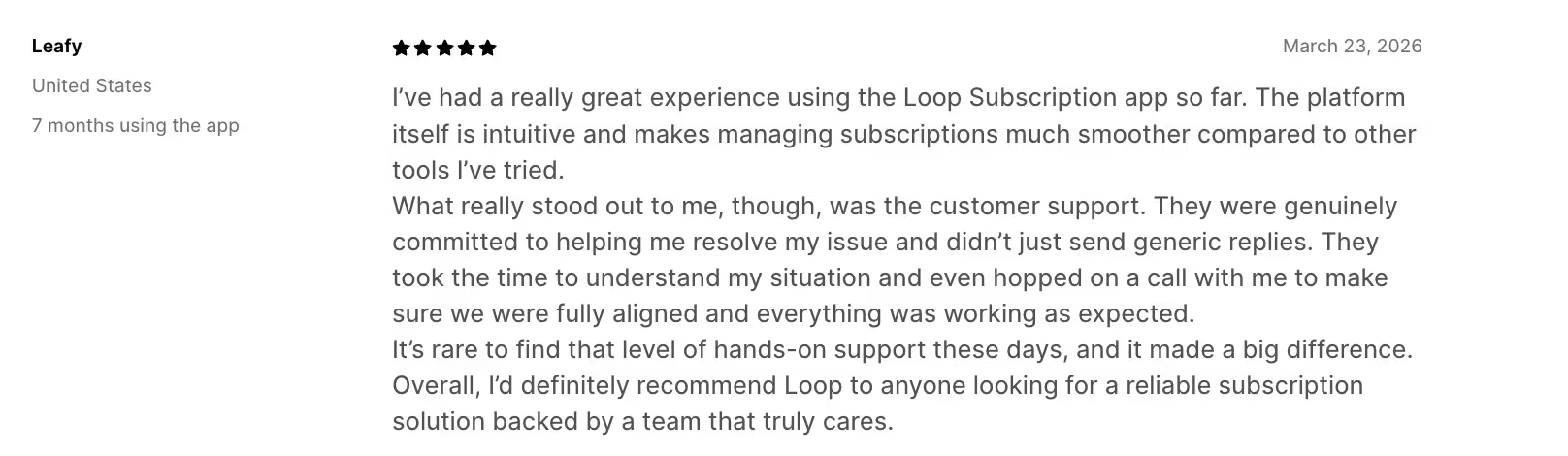
"I’ve had a really great experience using the Loop Subscription app so far. The platform itself is intuitive and makes managing subscriptions much smoother compared to other tools I’ve tried. What really stood out to me, though, was the customer support…” — Leafy, March 2026, Loop Shopify App Store
Loop Subscriptions is a leading independent subscription platform on Shopify — 2,400+ subscription brands, $4B+ in subscription revenue processed, 1,100+ migrations to date including 400+ from Recharge. Pricing starts at $99/month + 1.0%. No per-order fees. 4.9 stars across 650+ Shopify App Store reviews as of May 2026.
Recharge. Largest install base on Shopify (20,000+ merchants) and acquired Skio in April 2026. Pricing starts at $25/month (50-subscriber cap, net-new merchants only), with Starter at $99/month + 1.49% + 19¢/order and Plus at $499/month + 1.34% + 19¢/order on a 12-month term commitment. 4.8 stars across 2,100+ Shopify App Store reviews as of May 2026.
Stay AI: Plans start at $499/month + 1% + 19¢/order. 5.0 stars across 140+ Shopify App Store reviews as of May 2026.
Skio (now part of Recharge): Acquired by Recharge for $105M in April 2026. Plans start at $599/month + 1% + 20¢/order.
Book a demo to see how your current retention setup compares. Or explore the demo store to experience the subscriber journey yourself.
¹ On involuntary churn from payment failures, see Recurly's analysis of failed payment recovery, which cites involuntary churn as 20-40% of total subscription churn, and Churnkey's involuntary churn benchmarks, based on analysis of 5.4M failed payments and 25M subscriptions. Range cited reflects published industry figures; merchant-level impact varies by category and subscription model.
Source Attribution: Competitor pricing, ratings, and review counts are based on each platform's official website and Shopify App Store listing, verified May 2026. Features and pricing may have changed since publication.
Pricing Accuracy: Pricing information reflects publicly listed rates at the time of writing. Actual costs may vary based on negotiated contracts, promotional pricing, or plan changes. Merchants should verify current pricing directly with each platform.
Merchant Reviews: All merchant reviews cited are publicly available on the Shopify App Store as of the dates indicated. Reviews reflect individual merchant experiences, not Loop's characterization of any platform. Merchants quoted have not been compensated for their reviews.
Performance Claims: Where merchant outcomes are cited, results reflect individual merchant-reported outcomes and are not guarantees of typical results. Performance varies based on brand, product category, subscriber base, and implementation.
Trademark notice: Recharge®, Skio™, Stay AI™, Smartrr™, Ordergroove™, and Bold™ are trademarks of their respective owners. References to these platforms are for nominative comparative purposes only and do not imply affiliation, endorsement, or sponsorship.
Editorial Independence: This content is published by Loop Subscriptions, a competitor of the platforms discussed. While competitor information is sourced from public documentation as of the verification date above, readers should conduct their own evaluation before making platform decisions.
Corrections: Platform features and pricing evolve frequently. If you represent a platform listed and believe any information is factually inaccurate, please contact us at contact@loopwork.co and we will review and correct promptly.